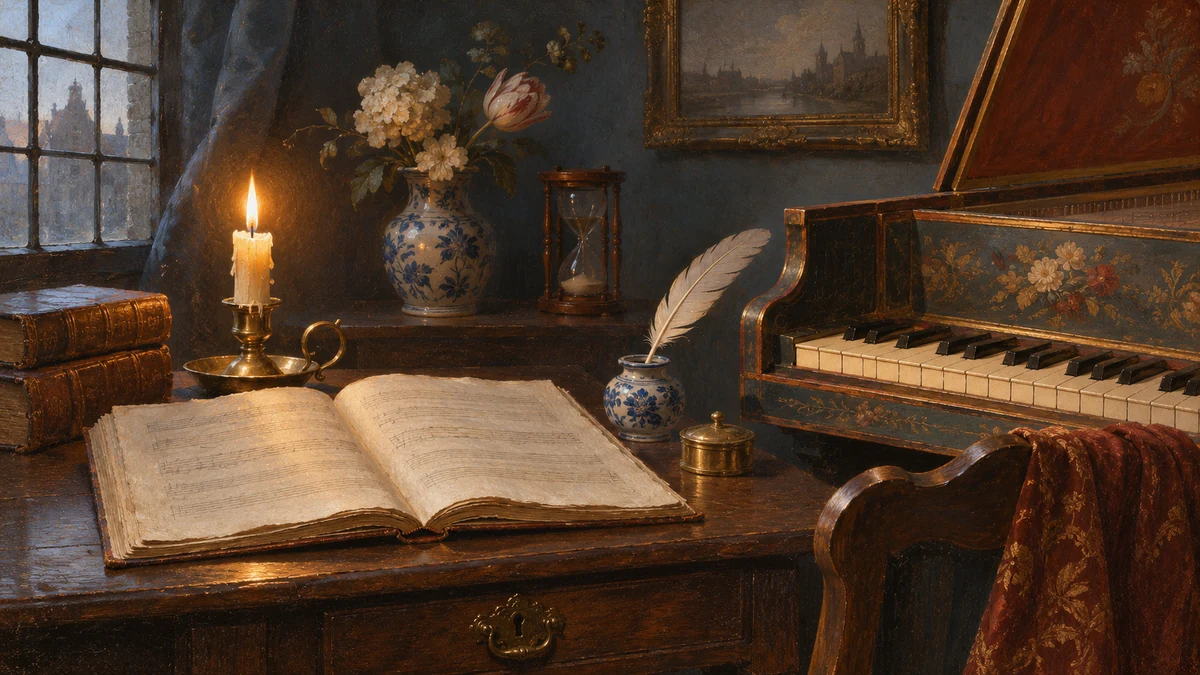
Medieval singers were sometimes taught to avoid the tritone. The devil appears in the surviving written record centuries later, in a lesson about how to write a singable tune.
In Johann Joseph Fux’s 1725 textbook, a teacher stops his pupil over a leap between two notes. He reminds him of an old saying: mi contra fa est diabolus in musica — “mi against fa is the devil in music”. Then he explains the problem. The leap is hard to sing and, in this exercise, sounds bad.
That is a long way from the familiar story of medieval monks forbidden to sing a pair of notes. The nickname is real. The supposed Church ban has no known documentary support.
What is a tritone?
On a modern piano, play C and then F♯. Count six semitone steps between them and you have a tritone, named for its span of three whole tones. In modern equal temperament, it divides the octave exactly in half. Earlier tuning systems could give slightly different sizes to the two intervals that we now group under that name.
The sound depends on what comes next. The opening riff of Black Sabbath’s “Black Sabbath” (1970) lets the interval hang ominously. In “Maria” from Leonard Bernstein’s West Side Story, the first two notes of the name make the same kind of leap. The melody then moves up another semitone and lets the tension open out. You can hear the difference without knowing the name of either note.
The medieval problem
Medieval singers learned pitches using six-note patterns called hexachords. They sang the syllables ut, re, mi, fa, sol, la. The half step always fell between mi and fa within a single pattern. The syllables could refer to different pitches in different patterns.
That makes the old warning easy to misread. The ordinary half step between mi and fa was part of the system. Trouble could arise when the syllables came from different hexachords. B natural, sung as mi in one pattern, sits a tritone away from F, sung as fa in another. Using B flat instead narrowed the distance to an ordinary fourth.
Around 1325, the theorist Jacobus of Liège described the tritone as difficult to sing. He also acknowledged that such intervals could occur in ecclesiastical chant. Teachers had reasons to avoid certain awkward leaps and composers had reasons to use dissonance. Surviving practice leaves room for both.
Where the devil came in
An early written witness is Andreas Werckmeister’s 1702 Harmonologia Musica. Werckmeister attributed the devil language to earlier authorities and discussed the expression in connection with awkward musical relationships. His account helps date the wording in print. It gives us no named medieval source for it, and the original date of the saying remains uncertain.
Fux put the proverb in his widely used counterpoint textbook Gradus ad Parnassum in 1725. Counterpoint is the craft of fitting independent musical lines together. In Fux’s dialogue, the pupil makes a tritone leap during an exercise. The teacher invokes the saying and tells him why the leap is a problem there. The warning concerns the writing and singing of a line. Related examples can be found in the promises on Victorian circus posters.
How the interval earned its reputation
Later composers could use the same tension deliberately. The opening of Liszt’s Dante Sonata gives the tritone a stark, recurring role. In Saint-Saëns’ Danse macabre, the solo violin’s top string is tuned down so that two open strings sound a tritone together. It is an effect you can hear before you know anything about the tuning.
Black Sabbath brought that unsettling sound to a new audience. Slayer went further with the nickname, calling their 1998 album Diabolus in Musica. By then, the old phrase could make an effective album title even for someone who had never seen a page of Fux.
What the evidence says
MYTH as a Church ban. Medieval theory and practice show caution about the tritone. The nickname is documented in early eighteenth-century teaching texts. The records give us no Church decree banning it and no securely identified medieval source using the devil nickname.
The ban story survives because it fits the sound of certain pieces so well. Hear the opening of “Black Sabbath” and you can imagine someone wanting to forbid it. Hear the opening of “Maria” and the same six semitones are doing a different job. Other stories about music, censorship and the law include the radio ban on an instrumental record and the copyright fight over Happy Birthday.
Sources & further reading
- Andreas Werckmeister, Harmonologia Musica (1702), and Store norske leksikon’s entry on the tritone.
- Johann Joseph Fux, Gradus ad Parnassum (1725), pp. 51–52.
- Tritones in early music, including Jacobus of Liège and examples from early practice.
- Medievalists.net on the supposed Church ban and Open Culture’s account of the myth.
- Fender, The Devil’s Chord, for the interval in popular music.
- Sydney Symphony Orchestra, Alessio Bax in Recital programme notes, on Liszt’s Dante Sonata.