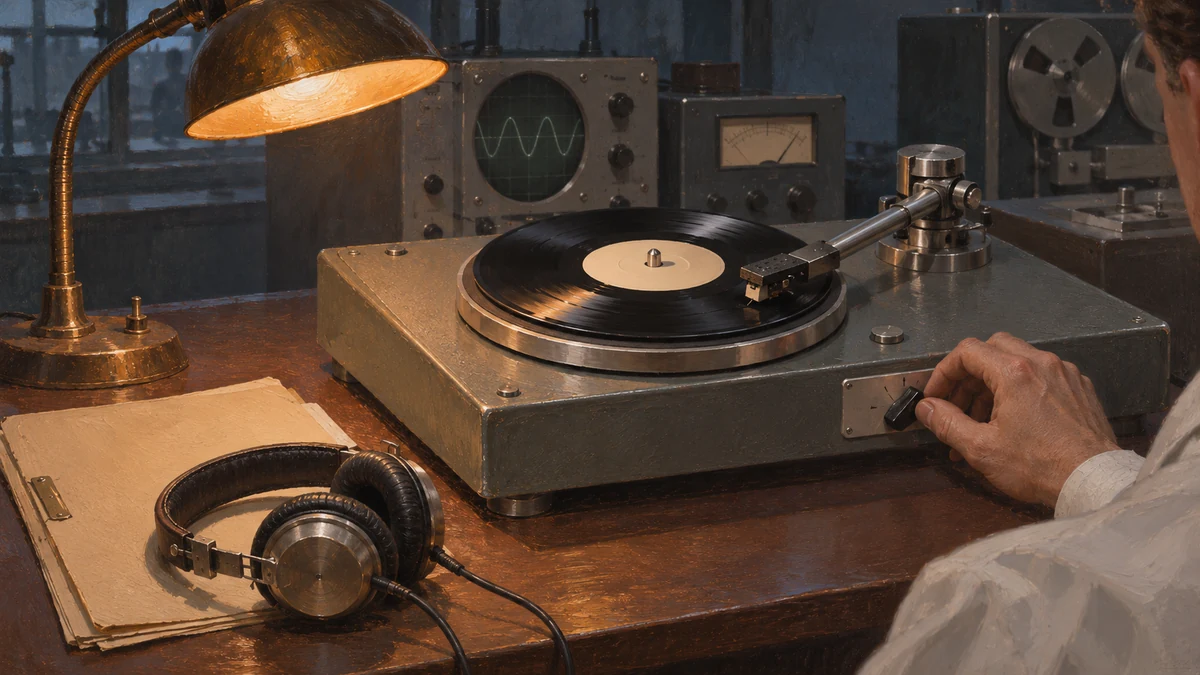
Teenagers passed around supposedly obscene lyrics to a three-chord party song. The FBI played the record at different speeds, and the words still eluded its examiners.
In March 1964, an FBI Laboratory report listed a Kingsmen single and two sets of words. One contained the published lyrics of “Louie Louie”. The other was a purported transcription, full of obscenities. The examiners had a straightforward question. Which set, if either, could they hear on the record?
The short answer
The FBI investigated because complaints alleged that the Kingsmen’s recording contained obscene lyrics and that distributing the record across state lines might violate federal law. The bureau tested copies at different speeds and could not reliably make out the disputed words. In December 1965, a federal prosecutor recommended ending the inquiry for lack of evidence. No charges followed.
A fifty-dollar recording session
Richard Berry’s original recording came out in 1957. His song is about a sailor who wants to get back to the woman he loves in Jamaica. Rockin’ Robin Roberts and the Wailers made it a Pacific Northwest favourite, and the Kingsmen picked it up. Another angle on theatre and stagecraft comes from the circus poster behind Being for the Benefit of Mr. Kite!.
The Kingsmen recorded it in Portland, Oregon, in spring 1963, at a session commonly remembered as costing $50. Singer Jack Ely had to project upwards towards a boom microphone above his head. He later recalled straining to be heard over the instruments. The result was a spirited record with a vocal that sounded as if it had come from the far side of the room. In clubs and at parties, nobody needed a transcription to dance to it.
The lyrics people thought they heard
As the record spread, so did sheets purporting to reveal the words that were supposedly hidden in Ely’s performance. The sheets circulated among teenagers. Different listeners could hear different things in the same blurred syllables, especially if somebody had already handed them a set of words to listen for. Related examples can be found in the history of maypole dancing.
In January 1964, a complaint reached Indiana governor Matthew Welsh. He asked broadcasters to stop playing the record after judging the supposed lyrics pornographic. That request and the decisions of individual stations helped make the rumour a public controversy. Complaints also reached the federal authorities. A three-chord recording was about to become a question for a laboratory.
What the FBI actually did
In February 1964, the FBI’s Tampa office sent a copy of the single and both sets of lyrics for examination. A report dated 4 March 1964 documented difficulty understanding the recording. Another laboratory report in April said the words could not be determined with enough certainty to judge whether the record was obscene.
The later file documents repeated listening. In March 1965, for example, a federal prosecutor and others listened at 45 and 33 rpm and still could not discern the alleged words. A 17 May 1965 FBI letter relayed that the Justice Department had been unable to interpret the recording either. The familiar summary, “unintelligible at any speed”, captures the result. The claim that the FBI played it backwards often appears in retellings, but the different-speed tests are what the cited documents clearly establish.
The FBI Vault’s summary gives February to May 1964 for the limited investigation. The released file, roughly 120 pages, also contains follow-up work in 1965. In September, the lab compared a tape made from the original recording with a disc previously submitted. On 2 December 1965, Assistant U.S. Attorney Robert J. Grace told the FBI he saw no evidence of an interstate obscenity violation and recommended no further investigation. The December report preserves that recommendation. The paper trail spans nearly two years, with no reason to picture two years of continuous listening.
The FBI had the lyrics
The published words were already listed in the first lab report. In August 1965, an FBI report recorded that a music-company representative showed agents the lyrics submitted for copyright and supplied sheet music that matched them.
That still left the question that had brought the record to the lab. A sheet tells you what Berry wrote. The investigators were trying to determine what the Kingsmen had actually put on the disc. The existence of the authorised lyrics could not by itself establish what the singer had sung in a noisy recording.
The noise at fifty-four seconds
Rock historian Peter Blecha has identified what he hears as a brief swear word around 0:54, attributed to drummer Lynn Easton after a mishap with a drumstick. If that reading is right, the sound is a stray exclamation. The supposed coded verses were a different claim altogether.
“Louie Louie” went on to become one of rock’s most frequently covered songs. Its investigation is a case study in how a rumour about hidden words can give listeners something to hear. Once somebody hands you an alleged lyric sheet, it takes work to listen to the record without it. Compare this with the radio ban on an instrumental record.
Sources & further reading
- FBI Vault, Louie Louie case file, especially the March 1964 lab report, the May and August 1965 correspondence and the December 1965 Detroit report.
- FBI Vault collection summary, also reproduced by the University of Nebraska–Lincoln.
- Jim Scheppke, The Kingsmen, The Oregon Encyclopedia, and Portland Monthly’s oral history of the session.
- NPR, “Louie Louie”: Indecipherable, Or Indecent?, via KAWC.
- The Washington Post’s obituary of Jack Ely, including Peter Blecha’s account.
- Dave Marsh, Louie Louie: The History and Mythology of the World’s Most Famous Rock ’n’ Roll Song (1993).