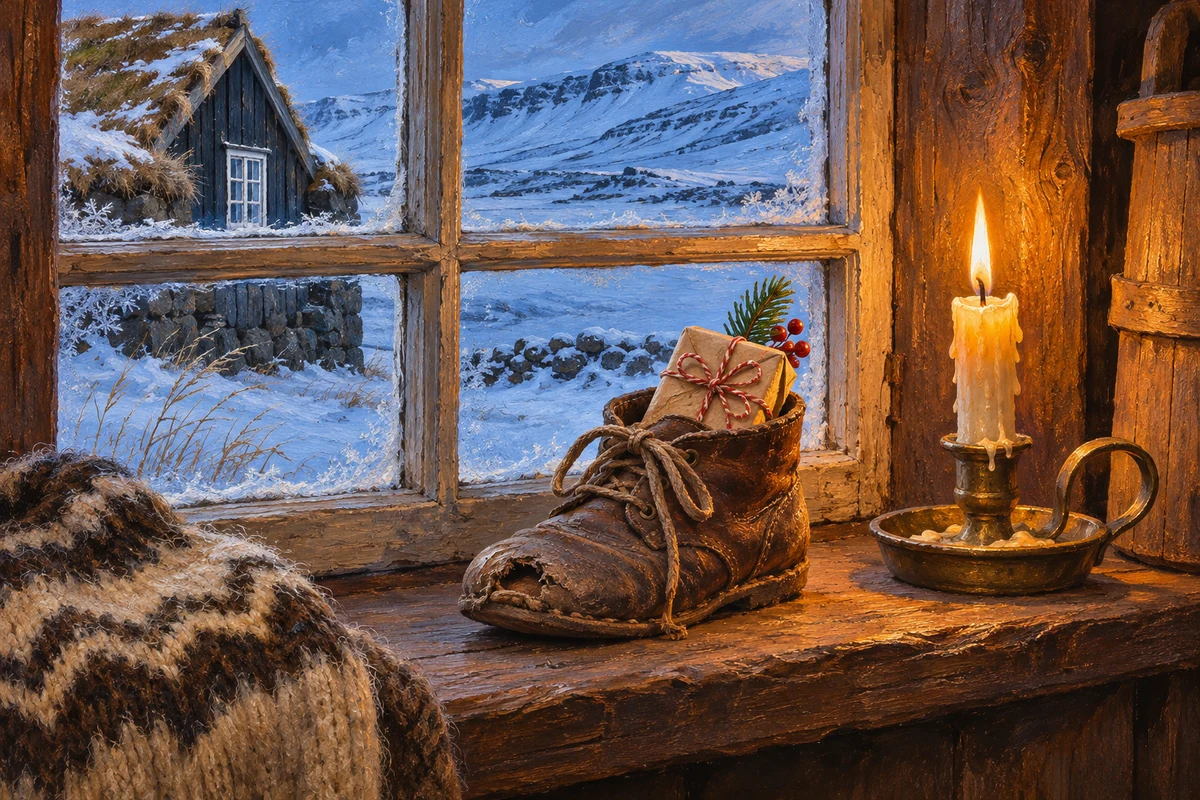
On 12 December, Iceland’s first Yule Lad comes down from the mountains. His name is usually translated as Sheep-Cote Clod. Twelve more follow, one at a time, with names that make it sound as though someone has been keeping a list of household complaints.
The short answer
Iceland had stories about mischievous Christmas visitors long before it had one familiar list of thirteen. The poet Jóhannes úr Kötlum drew on earlier folklore for his illustrated 1932 book Jólin koma, or Christmas Is Coming. His poem helped fix the names, number and order most people recognise today. In the modern custom, children leave a shoe on the windowsill for each visitor. It might hold a small gift by morning, or a potato.
A visitor for every kind of nuisance
The names make sense in a household where food and sleep matter. Spoon-Licker has an eye for kitchen utensils. Door-Slammer announces himself at an hour when the household would prefer silence. Other names point towards the sheep, the milk and the cooking pots. Read together, they give us a Christmas story set among the ordinary jobs and small worries of a farmhouse. Related examples can be found in the secret-code theory about The Twelve Days of Christmas and the Twelfth Night bean king.
In folklore the Lads are sons of Grýla and Leppalúði, a pair of mountain-dwelling trolls. Grýla is the more formidable figure, a threat invoked against misbehaving children. The modern window-shoe custom has room for both sides of the story. There is the pleasure of a gift and the comic indignity of finding a potato instead.
The book that gave them a timetable
The National and University Library of Iceland traces most of the names in Jóhannes’s poem to a list recorded roughly seventy years earlier in Jón Árnason’s folklore collection. The book put a particular version of the visitors in front of a wide audience. It gave families a memorable order to follow, right up to the arrival of the final Lad on Christmas Eve. Compare this with Queen Charlotte’s Christmas tree.
The pictures helped change how readers saw them. Tryggvi Magnússon illustrated the Lads in familiar clothes and at ordinary human scale. In the library’s account, these figures looked closer to farmers than to formidable trolls. The library preserves the original drawings, so that change can be seen as well as described.
What the evidence actually says
The year 1932 gives us a firm date for the influential book. It gives us neither the birthday of the Yule Lads nor the first night a child put a shoe on a sill. The stories were older, and the library describes the shift towards gift-giving as gradual.
What the book helped establish was a familiar cast that could come back in the same order each December. An individual Lad could still be a nuisance. Taken together, they gave children thirteen reasons to look at the windowsill in the morning.
Related curiosities
Why Do We Hang Stockings at Christmas?
Why Do Children Leave Shoes Out for St Nicholas?