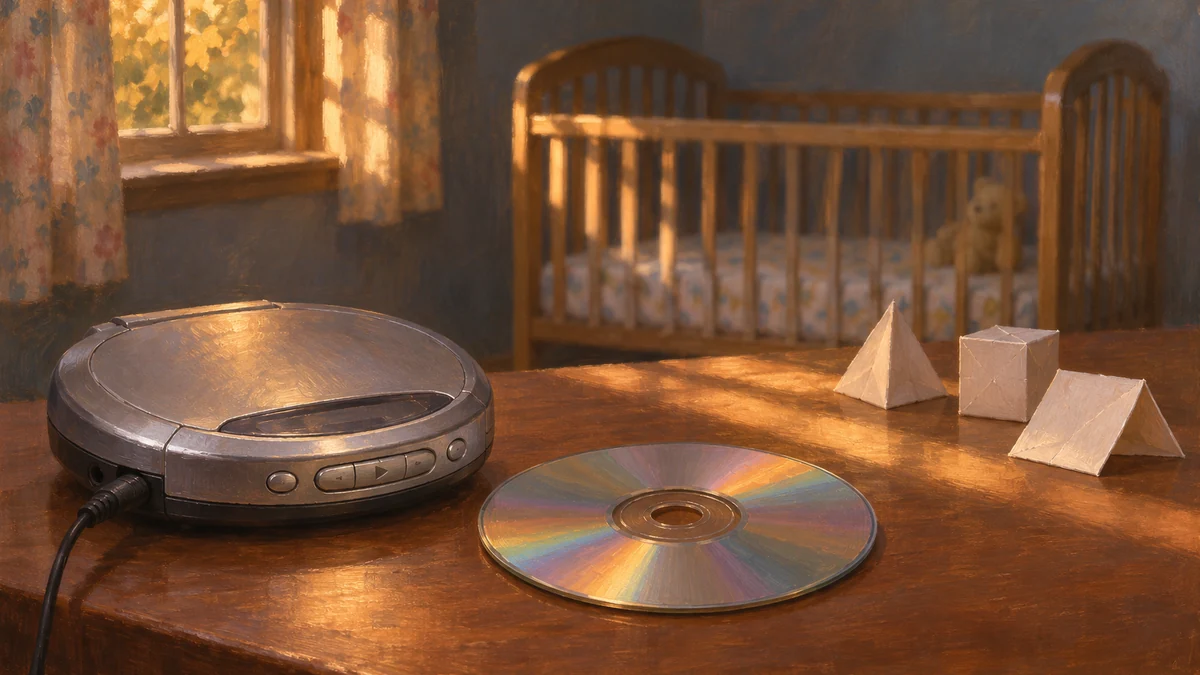
A one-page study of 36 college students became a promise about babies. Five years later, Georgia was arranging for classical music recordings to go home with newborns.
In January 1998, Georgia governor Zell Miller stood before state legislators and proposed giving the parents of every newborn a classical music recording. To make his case, he cited an experiment in which college students listened to Mozart. He described the result as a nine-point rise in IQ.
The students really did listen to Mozart. The number came from a score the researchers calculated for a handful of reasoning tasks. By the time the finding reached the Georgia legislature, it had acquired a new audience and a much bigger promise.
The short answer
No. The 1993 Mozart study gives us no reason to think playing Mozart makes babies smarter. It reported a brief improvement on spatial reasoning tasks in college students. The researchers tested no babies and did not administer a full IQ test. Later research found little evidence of a benefit specific to Mozart.
What happened in the lab
In 1993, Frances H. Rauscher, Gordon L. Shaw and Catherine N. Ky of the University of California, Irvine published a one-page report in Nature. Their 36 college students went through three listening conditions. Each lasted ten minutes. In one they heard Mozart’s Sonata for Two Pianos in D major, K. 448. In another they listened to spoken relaxation instructions. In the third they sat in silence.
After each condition they took one of three abstract or spatial reasoning tests drawn from the Stanford–Binet scale. The tasks included pattern analysis, matrices and paper folding and cutting. That last task asks you to imagine what a folded sheet will look like when it is opened after a cut. It measures a particular kind of mental manipulation. Compare this with the dance moves that look like zombies today.
Scores were higher immediately after Mozart. On the researchers’ converted spatial score scale, the difference was about eight or nine points compared with the other conditions. The paper described the advantage as lasting around 10–15 minutes. The number sounds more dramatic when the word spatial disappears. A short-lived difference on those tasks tells us very little about a person’s general intelligence.
How students became babies
Researchers Adrian Bangerter and Chip Heath tracked the story through newspaper coverage. Their 2004 study found that references to college students declined over time, while coverage increasingly associated the effect with children and babies. The original experiment stayed the same. The people it was said to help became younger.
Rauscher later told NPR how quickly the coverage took off. She recalled seeing a Mozart display in a record shop using quotations from the paper. In 1997, Don Campbell’s bestselling book The Mozart Effect brought the phrase to a wider audience. Recordings marketed to parents turned a memorable label into something you could buy and play at home. Related examples can be found in the Moon-landing association of Space Oddity and Blind Willie Johnson’s recording on the Voyager Golden Record.
Georgia’s newborn music plan
Miller’s 1998 budget proposal asked for $105,000 to provide classical music on tape or CD to the families of Georgia newborns. Legislative researchers in Connecticut reported that the appropriation became unnecessary because Sony offered to supply the recordings free of charge to Georgia hospitals. The hospitals were to include them among the items sent home with new parents. A University of Georgia study later described families receiving the recordings that summer.
The proposal was a one-off budget initiative and distribution arrangement. It is often remembered as a state law or an appropriation that paid for the discs, though the contemporary legislative account gives a different picture.
What later research found
In 2010, Jakob Pietschnig, Martin Voracek and Anton K. Formann pooled nearly 40 studies involving more than 3,000 participants. They found a small average advantage on spatial tasks after Mozart compared with silence or a non-musical condition. Other music showed a similar advantage. They also found evidence of publication bias, which can make an effect look larger when studies with positive findings are easier to find.
That is more precise than saying every experiment found nothing. The review found little support for a Mozart-specific effect. A temporary change in how someone approaches a task can be interesting without implying a lasting change in how that person thinks. Rauscher herself told NPR that the claims had been stretched far beyond what her team studied.
Why the story stuck
The idea offered parents a simple action at a time when they were hearing more about the importance of a child’s early years. A number, a famous composer and a ten-minute task were easy to remember. So was a picture of a baby listening to a CD. The qualifications took longer to explain.
Learning an instrument is a separate question. It involves practice, feedback and developing musical skills over time. Research on whether those gains carry over to broad measures such as general intelligence or school attainment depends heavily on study design. The pleasure of sharing music and the skills children can develop by making it have their own value.
Sources & further reading
- Frances H. Rauscher, Gordon L. Shaw and Catherine N. Ky, Music and spatial task performance, Nature 365, 611 (1993), and a copy of the original page.
- Adrian Bangerter and Chip Heath, The Mozart Effect: Tracking the Evolution of a Scientific Legend (2004).
- Georgia Senate Journal, 1998, and Connecticut’s Office of Legislative Research, Georgia’s Provision of Classical Music for Newborns.
- Jakob Pietschnig, Martin Voracek and Anton K. Formann, Mozart effect–Shmozart effect: A meta-analysis, Intelligence 38 (2010).
- NPR, “Mozart Effect” Was Just What We Wanted To Hear, via KPBS, and Britannica’s overview.
- Davi A. Johnson, The Rhetorical Brain, University of Georgia, and Giovanni Sala and Fernand Gobet, meta-analysis of music training and broader cognitive and academic outcomes.