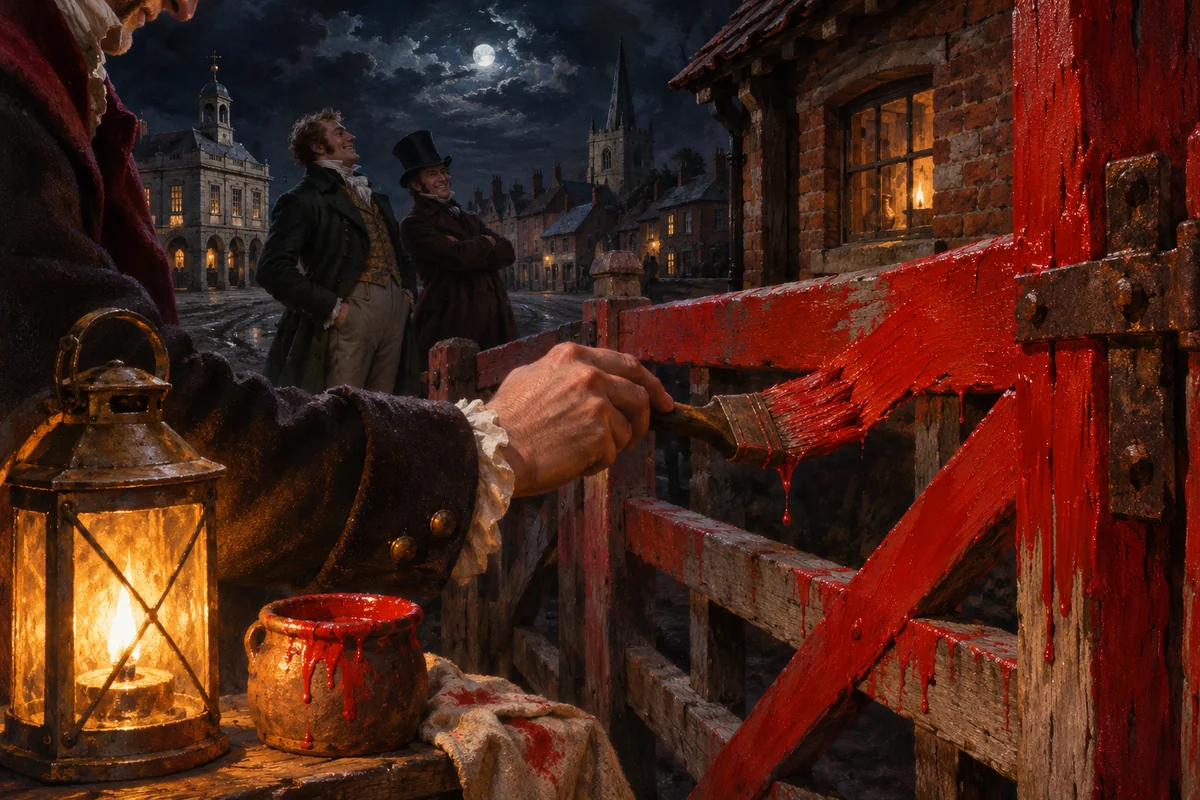
Melton Mowbray has a wonderfully literal explanation for a night of painting the town red. In 1837, a party of aristocrats caused havoc there with pots of paint. The awkward part comes when you look for the expression in old newspapers. Some of the earliest examples turn up on the other side of the Atlantic.
The short answer
To paint the town red is to go out and celebrate noisily or extravagantly. The story that it began with the Marquess of Waterford’s drunken escapade has a real incident behind it, but the link to the expression remains unproved. The early written evidence shows that the phrase was circulating as American slang by 1881. Compare this with the false trail behind red herring.
The night Melton Mowbray really did turn red
On 6 April 1837, Henry de la Poer Beresford, the third Marquess of Waterford, and a group of friends were returning from the races at Croxton Park. The account assembled by Melton Carnegie Museum describes trouble at a tollhouse, followed by a spree through town.
Doors and windows were daubed with red paint. The group reportedly went after the white swan displayed high on an inn and smeared a watchman who tried to intervene. The museum records that the Marquess and three others were eventually fined £100 each.
The museum’s young researchers used newspaper reports from the period to reconstruct the trial. Those records are evidence that the town had a good reason to remember that night. To trace the idiom, though, we need a different sort of record. We need someone using those words as a saying.
What the American newspapers say
On 3 November 1881, the Courier-Journal of Louisville, Kentucky, used “painting the town red” in a brief item about a man named James Crockett. The writer put the words in quotation marks but supplied no account of anyone buying paint or wielding a brush.
A West Virginia newspaper made the meaning clearer. In a satirical dialogue published in the Weekly Register of Point Pleasant on 18 January 1882, a child asks his father about the habits of a state legislator. The father explains that the legislator fortifies himself with drink before making a florid speech or painting the town red. The joke treats the phrase as something readers can understand without a story about an English marquess.
Other early examples collected by Merriam-Webster, including two from the Cincinnati Enquirer in 1882, also associate it with drinking and causing a stir. By 1884, newspapers could use it for a public celebration. A Hawaii report associated the phrase with a proposed torchlight procession, while a Tennessee report applied it to election celebrations with fireworks.
How a spree became a night out
Those examples give us a glimpse of the phrase at work. It could describe a drunken disturbance, but it could also describe a crowd making a tremendous noise because its side had won. The common element was a display big enough for the rest of the town to notice.
Today, you can paint the town red by going dancing after a wedding or taking friends out to celebrate a new job. As Merriam-Webster notes, drinking was a prominent feature of many early examples. The modern phrase is broad enough to cover an exuberant night out with or without it.
What the evidence actually says
The Melton story has everything an origin story could wish for. There is a place you can visit, a culprit you can name and paint in precisely the right colour. Yet the surviving examples leave a gap of more than four decades between the incident and the early American uses. A phrase can circulate in speech before appearing in print, so the gap alone cannot rule out a connection. It does leave the connection to be demonstrated.
There is a second appealing possibility. Pascal Tréguer, who collected the early American citations, suggests that torchlight or fireworks might have inspired the phrase. The 1884 reports show how readily people associated the image with a town lit up for a celebration. Since the phrase was already in use by then, those reports cannot tell us where it started.
The best-supported conclusion is that the English spree and the American slang are both documented. How the saying arose, and why red was the colour it settled on, remain open questions.
Why it stuck
A town painted red is an image out of all proportion to an ordinary night out. That is part of its charm. You can use the phrase to promise a grand celebration even if your plans extend only as far as dinner and the last train home. The exaggeration does the work, and the marquess gives us an excellent story to tell afterwards. Related examples can be found in Coca-Cola’s influence on Santa’s image and Robert Johnson’s crossroads legend.
Related curiosities
Why Do We Say “Close, But No Cigar”?
Where Did “The Whole Nine Yards” Come From?
Why Do We Say “Steal Someone’s Thunder”?
Sources & further reading
- Melton Carnegie Museum — Painting the Town Red
- Melton Carnegie Museum — Melton Young Researchers: Painting the Town Red
- Merriam-Webster — When Do We Paint the Town Red?
- Pascal Tréguer, Word Histories — Early American examples and a hypothesis for the phrase’s origin
- Library of Congress — The Weekly Register of Point Pleasant, West Virginia
Last checked: 25 November 2026.