One of the clearest early accounts of a bluesman trading his soul for guitar skill is about Tommy Johnson. How did Robert Johnson become the man at the crossroads?
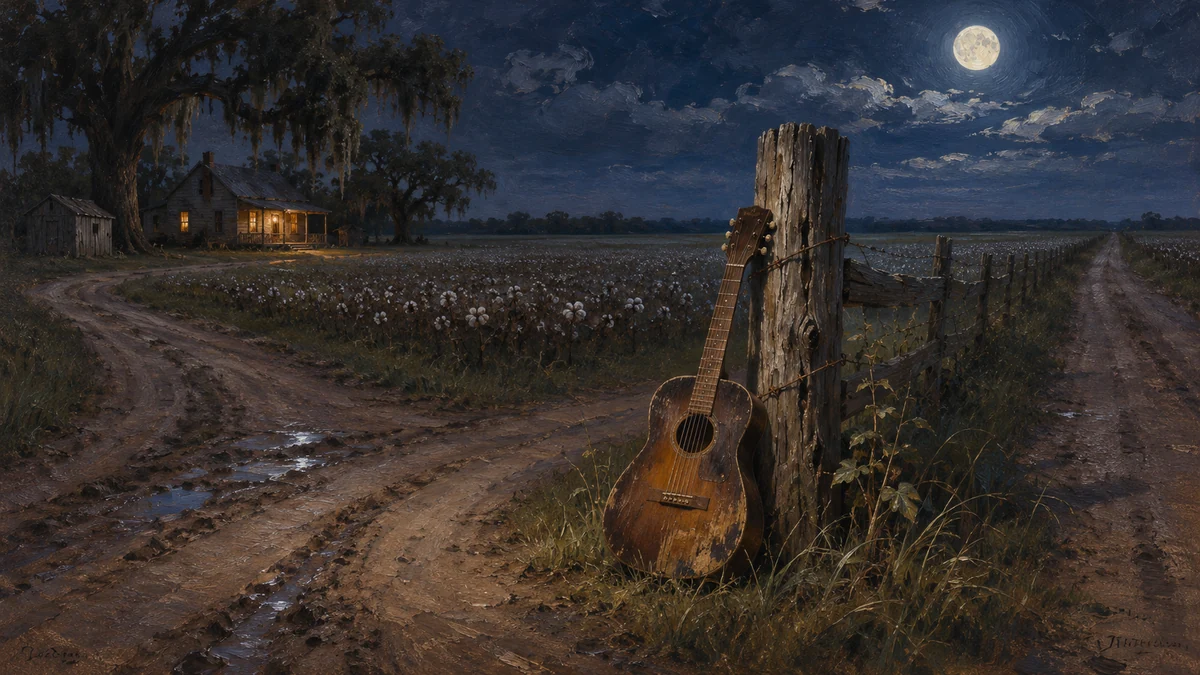
At midnight, a guitarist waits where two roads meet. A stranger takes his guitar, tunes it and hands it back. From then on he can play as he never could before. The price, in the familiar telling, is his soul. Clarksdale, Mississippi, marks the meeting of Highways 61 and 49 as the crossroads of the legend. The landmark tells us where the story is celebrated. Robert Johnson left no known contemporary account placing himself there.
The short answer
The pact is a myth as a story about Robert Johnson. One of the clearest early recorded accounts concerns Tommy Johnson, a different Mississippi blues musician and no relation. Robert’s striking improvement as a guitarist, the imagery in his recordings and his early death gave the story a new home. We can trace several strands of that history, though there is no single documented moment when the full legend became his.
The other Johnson
In 1966, folklorist David Evans recorded an interview with Tommy’s brother LeDell Johnson, a blues musician who became a preacher. LeDell recalled Tommy telling the family that he had sold himself to the devil. In the story he passed on, a figure at a crossroads takes the guitar, tunes it and plays before returning it. Related examples can be found in Blind Willie Johnson’s recording on the Voyager Golden Record.
Evans published a version in Tommy Johnson in 1971. You can hear part of LeDell’s interview in Radiolab’s “Crossroads”. It is oral testimony about what Tommy was said to have claimed. Whether Tommy meant it as a boast, a joke or something else is harder to recover. LeDell’s move from the blues to preaching gives the tale a religious context, but the recording leaves room for more than one reading of his motives.
How Robert got so good
Son House remembered a young Robert Johnson who was keen to play guitar and awkward enough at it that other people wished he would stop. Then Johnson went away. When he returned, House recalled, the improvement astonished him. The memory became part of the story told during the 1960s blues revival. In 1966, writer Pete Welding reported a devil-pact explanation associated with House. That was decades after the events he remembered.
There is a human story in the interval House could only describe as an absence. Johnson learned from Isaiah “Ike” Zimmerman, whose surname also appears as Zinnerman or Zinermon. Research drawing on Zimmerman’s family describes Johnson staying with them and the two men practising in a cemetery at night. The graveyard sounds like a detail invented for the legend. In the family account it was a quiet place to play without bothering anyone.
Two songs, one story
“Cross Road Blues” puts a man at a crossroads. He appeals to the Lord for mercy and tries to flag a ride. There is no devil bargaining for his soul. “Me and the Devil Blues” brings the devil to the singer’s door. There is no crossroads bargain there either. Read the titles side by side and they can sound like the two halves of a single story. Listen to what Johnson actually sings and they remain two different songs. Other stories about the blues and the stories told about its performers include Lead Belly’s prison appeals and Mamie Smith’s breakthrough recording of Crazy Blues.
Johnson died on 16 August 1938, aged 27 by the generally accepted birth date. The cause remains uncertain. The often-repeated poisoning story is an allegation. The small surviving record of his life left later listeners plenty of room to fill in the gaps.
Older stories at the meeting of roads
The crossroads already had a life in folklore. Scholars have compared the keeper of the crossroads with figures such as Èṣù, or Eshu, in Yoruba tradition and Legba in West African and African diasporic traditions. Those figures have their own roles and meanings. Calling them versions of the Christian devil would flatten the traditions the comparison is meant to illuminate.
European tales of bargains with the devil, including the Faust story, offer another parallel. The blues legend has elements that resonate with several traditions. Pinning it to a single line of descent would go beyond what the evidence can show.
Why it lasted
Columbia’s 1961 LP King of the Delta Blues Singers brought Johnson’s 1930s performances to a new audience. The blues revival and rock musicians’ interest in his songs gave the legend more listeners. Walter Hill’s 1986 film Crossroads turned the bargain into fiction for a new generation. Johnson’s later association with the “27 Club” gave his death another place in popular mythology.
The most revealing part of the story is the time that disappears. In the legend, a man hands over an untuned guitar and gets it back with a lifetime’s skill. In the accounts of the people who knew Johnson, that interval held a teacher and many nights of practice.
Sources & further reading
- J. Michael Butler, Crossroads Myth, Mississippi Encyclopedia, and its Tommy Johnson entry.
- David Evans, Tommy Johnson (Studio Vista, 1971), and Radiolab’s Crossroads transcript, including the interview with LeDell.
- National Park Service, Robert Johnson, for the recording chronology.
- Greil Marcus, The Devil Had Nothing to Do With It, and Living Blues on Johnson and Zimmerman.
- Elijah Wald, Escaping the Delta: Robert Johnson and the Invention of the Blues (2004).
- Tom Graves, Crossroads: The Life and Afterlife of Blues Legend Robert Johnson (2008).
- American Film Institute, Crossroads (1986).
- Smithsonian Ralph Rinzler Archives, catalogue entry for the 1961 Columbia LP.