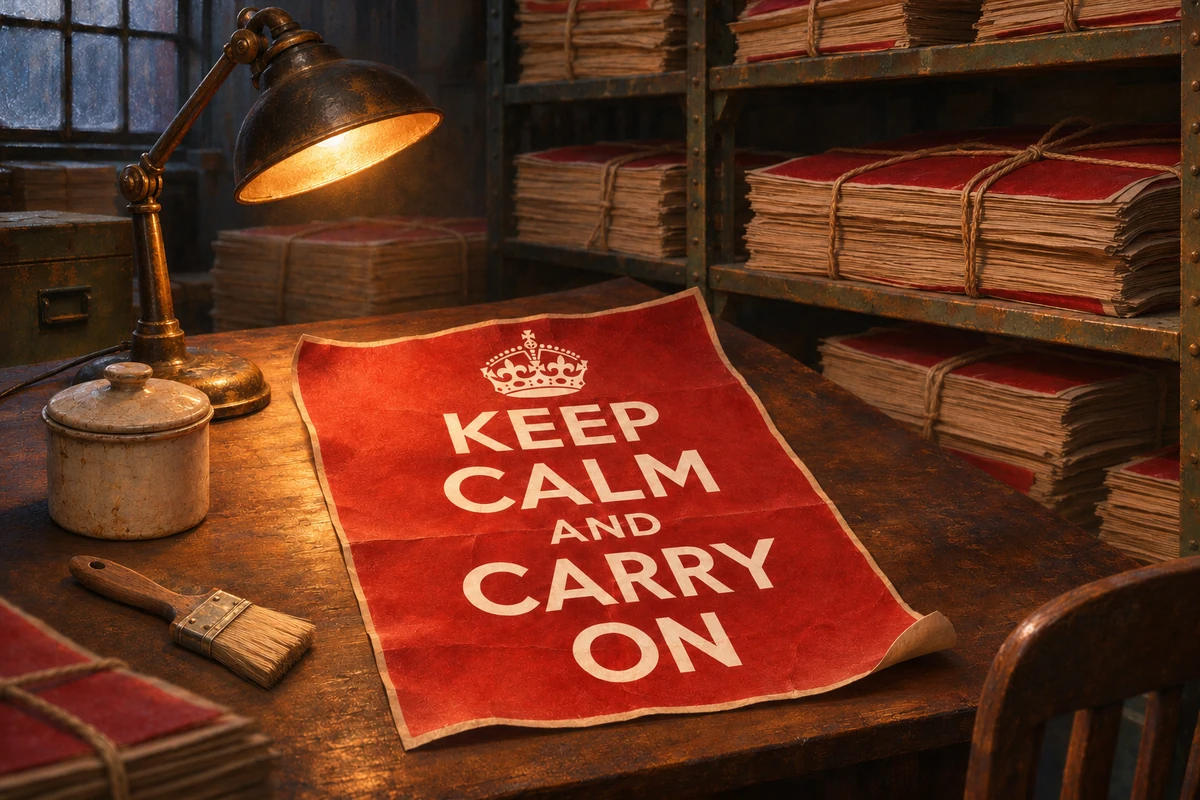
A crown. Five words. White lettering on red. The design seems to summon an entire country getting on with things while bombs fall. Its real history includes a government campaign that faltered, bundles of unused paper and a second-hand bookshop. There is also an awkward wartime document to complicate the neatest version of the tale.
The short answer
“Keep Calm and Carry On” was a genuine British government poster prepared in 1939. Its present-day fame largely followed its rediscovery around the turn of the millennium. It was never officially launched as the widespread wartime campaign people often imagine. But a surviving report mentions posters bearing the words being distributed in Cardiff in May 1940, so the claim that nobody ever saw one goes beyond the evidence.
A message prepared before the bombs
The Ministry of Information commissioned the design in the months before the Second World War began. It belonged to a group of messages intended to sustain civilian morale in an anticipated national emergency. Related examples can be found in the legend of the Angels of Mons and the number plate on Franz Ferdinand’s car.
Imperial War Museums’ study of the poster describes an earlier proposed wording, “Keep Calm. Do Not Panic”. The eventual five words offered a more composed instruction. They would later become almost inseparable from a popular image of British resilience.
A crown helped give the sheet official authority. Large lettering made the instruction easy to grasp. On a shop wall today, it can look like a compact piece of wartime wisdom, handed down intact from people who had lived through the worst.
The difficulty is working out how many of those people encountered it in the first place.
Printed, stored and reconsidered
Historian Henry Irving’s account, based on research into the Ministry, traces the slogan’s selection to the summer of 1939. About 2.45 million copies had reached local distribution centres when officials decided to hold back from public display until severe bombing began.
Irving also identifies contemporary unease over the tone. Officials worried that reassuring the public too insistently might irritate people or imply doubt about their nerve. The associated publicity campaign was abandoned after a few weeks. Stocks of “Keep Calm” began to be pulped from April 1940 during a paper shortage.
This was a printed government message with a troubled early life. Its later popularity can make the hesitation around it surprisingly hard to imagine.
The document that prevents a tidy answer
A Home Intelligence report dated 28 May 1940 contains a small but significant entry. Under Cardiff, the regional summary states that “Keep calm and carry on” posters were being distributed.
The report is available through the Ministry of Information’s digital research archive. It is a contemporary record, and it deserves a place beside later summaries saying the poster was never issued.
It leaves questions open. The brief entry gives no illustration, print details, number of copies or account of where they were displayed. We cannot establish from that line alone whether it refers to the familiar crown design, a local version or some other use of the words.
It does, however, make an absolute claim about total invisibility difficult to defend. A document written during the crisis records distribution of posters under that wording. There is more to investigate than a simple yes or no.
The bookshop afterlife
The story most people encounter begins much later. In 2000, a surviving poster was found at Barter Books in Alnwick, Northumberland. The shop’s association with the design became central to its revival.
An account published by the International Organization for Standardization describes the unexpected discovery in a second-hand bookshop and the global phenomenon that followed. Imperial War Museums’ later exhibition material likewise connects the poster’s public success to its rediscovery and reproduction in 2000.
The words now found a receptive audience. Copies, gifts and adaptations let people bring the reassuring instruction into ordinary life. A design that had largely missed its intended moment acquired a new one.
How familiarity became apparent memory
The poster is exceptionally easy to recognise and imitate. The crown and stacked words provide a format that survives even when the final instruction changes. Each adaptation helps keep the original in circulation.
That repeated familiarity can create an impression of uninterrupted historical importance. A person who has seen it in cafés, kitchens and shops may reasonably assume it was equally visible in wartime streets. Compare this with wartime escape maps hidden in playing cards.
This is an interpretation of its modern appeal, rather than evidence about a particular viewer’s memories. It explains why the poster’s present reputation needs to be checked against its documented use.
What the evidence actually says
WELL SUPPORTED applies to the poster’s 1939 origin and its much later popular revival. Museum accounts describe its very limited wartime visibility, while Irving’s research explains the abandoned official campaign.
The Cardiff report adds a qualification. It records distribution of posters bearing the phrase, with too little detail to identify the sheets conclusively. Both parts belong in the history.
A mug on a modern kitchen shelf tells us that the message has found an audience. To understand its wartime audience, we have to return to the documents, including the inconvenient ones.
Sources and further reading
- Henry Irving — Keep Calm and Carry On, the Compromise Behind the Slogan, History of Government
- Ministry of Information — Home Intelligence report, 28 May 1940, Cardiff regional entry
- Imperial War Museums — Bex Lewis, Keep Calm and Carry On, the Truth Behind the Poster, publication announcement
- Imperial War Museums — Emergency Exits exhibition guide, section on the poster’s rediscovery
- International Organization for Standardization — Keep Calm, the First Rule of Business Continuity, ISOfocus 125
- Barter Books — the Alnwick bookshop associated with the surviving poster