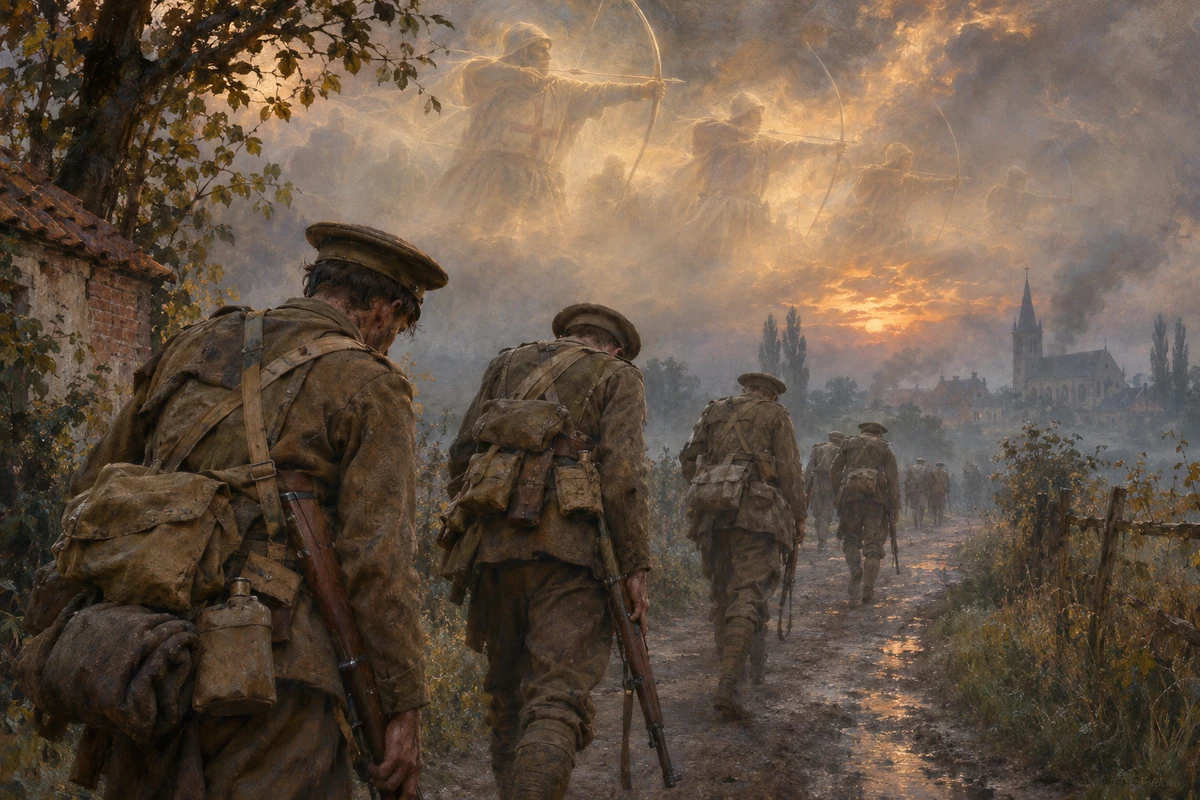
In 1914, a writer imagined ghostly archers coming to the aid of British soldiers. Within months, stories of supernatural protection were circulating as accounts of something that had actually happened. The writer’s attempts to explain himself became part of the argument.
The short answer
The Angels of Mons belong to one of the First World War’s most enduring legends. Supernatural figures were said to have protected British troops during their retreat from Mons in Belgium in August 1914. The strongest documentary trail leads through Arthur Machen’s short story The Bowmen, published the following month. Reports of apparitions subsequently circulated widely, but the surviving evidence does not establish that angels appeared on the battlefield. Related examples can be found in the wartime history of Keep Calm and Carry On and the number plate on Franz Ferdinand’s car.
What happened at Mons?
On 23 August 1914, the British Expeditionary Force fought German troops at Mons. The engagement was followed by a retreat. The National Army Museum preserves contemporary depictions of wounded men helping one another along the road, a reminder of the human ordeal behind the later legend.
The fighting had taken place far from most British readers. Newspapers and letters brought fragments home. Into that distance between a battlefield and the people trying to imagine it came an extraordinarily comforting story.
In its familiar form, heavenly protectors appeared when British soldiers were in danger. Sometimes they were angels. Sometimes they resembled a spectral army. The differences matter, because the story changed as it travelled.
The man who supplied the bowmen
Arthur Machen was a Welsh writer with an established interest in uncanny fiction. On 29 September 1914, London’s Evening News published his story The Bowmen.
In the tale, a British soldier facing an overwhelming German attack remembers an invocation to St George. Supernatural archers come to the soldiers’ aid. Machen had brought medieval English bowmen into a modern war, giving the men with rifles a ghostly connection to an older national past.
This was a piece of imaginative writing. Machen later explained its composition in the introduction to his 1915 collection, The Angels of Mons. He described thinking about the suffering of the soldiers and imagining help arriving for them.
His fiction offered something a casualty list could never provide. It pictured the soldiers as watched over, with assistance arriving at the moment it was most needed.
How a story became testimony
As Machen told it, readers began asking whether The Bowmen had a factual basis. Requests to reproduce it in religious publications followed. He explained that he had invented it. Some correspondents remained convinced that there must be a real event behind the fiction.
The author’s account is valuable evidence of how people responded to his work. It also needs to be read as his account of the controversy. Establishing the route taken by every later rumour is a larger task than identifying the publication of one story.
The Mons Memorial Museum describes a press culture in which local and national reports repeated one another. A story could acquire apparent confirmation simply by returning in another publication. An account heard at second hand might eventually arrive with the authority of something everyone had read.
Machen himself suggested that his luminous bowmen had become angels in the popular imagination. The supernatural helpers had grown beyond the form in which he had written them.
The story people wanted to hear
The legend soon reached audiences through more than print. In 1915, the Regal record label released a dramatised version of The Angels of Mons. Tim Crook’s research into early recorded drama examines how the episode was performed for listeners at home. The story also appeared in musical forms, including an Angels of Mons Waltz. Compare this with the prison-camp origins of deadline.
These were ways to encounter the legend repeatedly. A listener could hear it acted out, then come across it again in another setting. Familiarity helped make it part of the cultural landscape of the war.
It is reasonable to see consolation and patriotic reassurance in its appeal. That interpretation does not require us to assume that every believer had the same motive, or that anyone repeating the story was deliberately misleading others.
What the evidence actually says
DISPUTED describes the claimed battlefield apparition. The battle, Machen’s publication and the subsequent circulation of the legend are documented. The supernatural intervention remains unverified.
Machen’s story supplies a traceable early source for an influential version of the tale. His later insistence that he invented it is also on record. Neither a vivid retelling nor a large number of repetitions turns the reported angels into an established historical event.
Equally, guessing that exhausted soldiers must have hallucinated would go further than the evidence allows. An explanation of a particular witness’s experience requires a witness and a reliable account to examine. The responsible starting point is the documentary trail we actually have.
Why the angels stayed
The story gave people an image they could carry alongside the news from the front. Men facing an industrial war had allies from a distant, almost storybook past. For families waiting at home, that was an arresting possibility.
Machen could explain how he had written his bowmen. He had much less control over what readers did with them. The enduring curiosity of Mons lies in that moment when an invented scene began to be passed around as remembered history.
Sources and further reading
- National Army Museum — Battle of Mons, 23 August 1914
- National Army Museum — The Famous Four Days Retreat from Mons, 1914
- Arthur Machen — The Angels of Mons, including his introduction and The Bowmen, 1915, Project Gutenberg
- Australian War Memorial — Angel of Mons
- Mons Memorial Museum — The Angels of Mons exhibition press kit
- Tim Crook — Vocalizing the Angels of Mons, Societies, 2014