A last-minute route change brought Archduke Franz Ferdinand’s car to a stop near Gavrilo Princip. Years later, its Viennese registration, A III 118, acquired a second reading: Armistice, 11 November 1918.
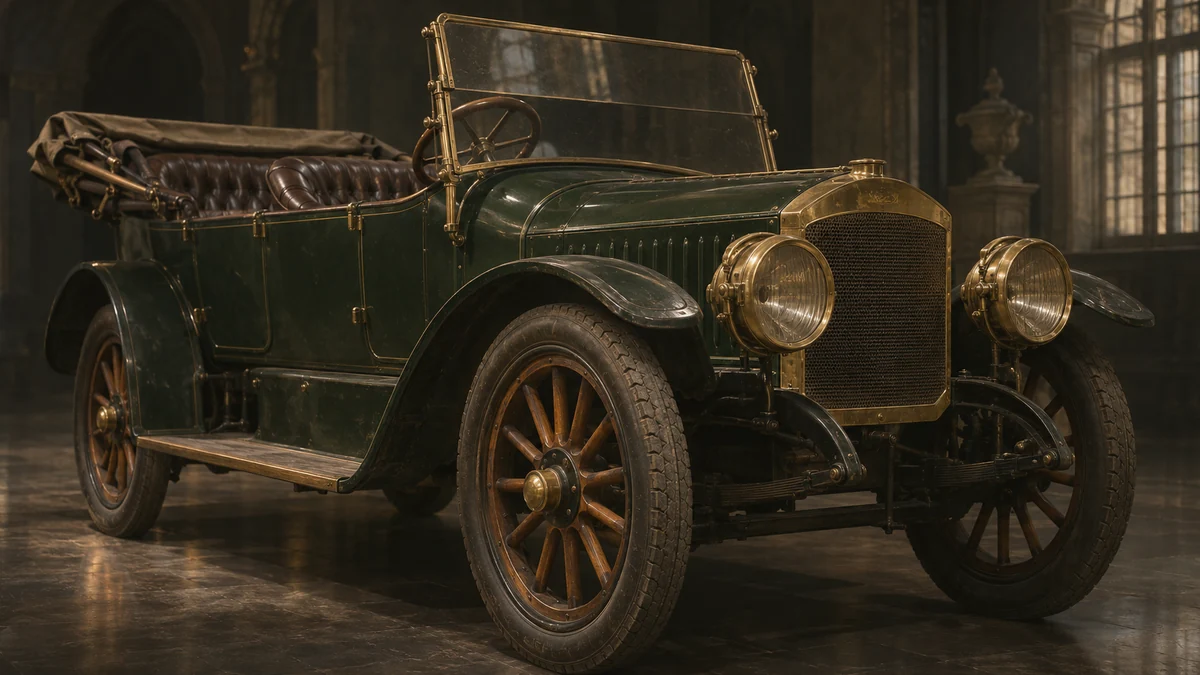
The Gräf & Stift in Vienna’s Museum of Military History still bears marks from two attacks on the same morning. At the front is a detail that can be easier to miss. The number plate reads A III 118. Read the three Roman strokes as ones, shift the spaces and give the A an English meaning, and the plate seems to tell you how the war ended. Read it as a Viennese motor registration, and it tells you something else entirely.
The bomb and the wrong turn
On 28 June 1914, Archduke Franz Ferdinand and his wife Sophie, Duchess of Hohenberg, were travelling to Sarajevo’s town hall when Nedeljko Čabrinović threw a bomb at their motorcade. It exploded by the following car, injuring several people, including Lieutenant Colonel Erik von Merizzi. Franz Ferdinand and Sophie continued to the town hall. Afterwards, the party decided to visit the hospital where Merizzi had been taken.
The change was made at short notice. Vienna’s Museum of Military History says the first car turned off the quay near the Latin Bridge, following the original route, and the archduke’s car followed. Governor Oskar Potiorek called out that they were going the wrong way. The chauffeur stopped to turn back. Gavrilo Princip was standing nearby.
The Czech National Heritage Institute identifies the chauffeur as Leopold Lojka, an employee of Count Franz Harrach, the car’s owner. The name Franz Urban appears in some retellings. The evidence for Lojka is stronger. The route mix-up is well documented, although the accounts are less clear on exactly what each driver had been told before leaving the town hall.
Two deaths and a month of decisions
Princip fired twice. Sophie and Franz Ferdinand were both mortally wounded. They were taken to the governor’s residence, where their deaths were confirmed.
The shootings set off the July Crisis. Austria-Hungary, encouraged by Germany, sent Serbia an ultimatum and declared war on 28 July 1914, a month after the assassination. Mobilisations and further declarations brought other powers into the conflict. The wrong turn explains how the car came to stop where it did. The decisions that turned two deaths into a world war took weeks.
What A III 118 actually meant
Harrach’s car was a Gräf & Stift double phaeton, an open touring car. The manufacturer’s history records its delivery to him on 15 December 1910. Harrach made it available for the archduke’s visit.
Under the registration system then used in the Austrian half of the monarchy, the initial A identified Vienna. Roman numerals supplied the thousands once three-digit numbers were exhausted. III 118 therefore represents 3,118 in the Viennese series. The spaces and the mix of characters belong to the registration system.
Was the plate already there in Sarajevo? Historian Mike Dash initially wondered whether it had been fitted later. He traced a period photograph to the illustration section of David James Smith’s One Morning in Sarajevo (2008). Dash says he could make out the same registration in a good copy under magnification, though his published crop is hard to read. The manufacturer history also gives A III 118 as the car’s registration. Together, those sources support the number’s use in 1914. The photo’s original archive credit and whether the surviving plate is the very same piece of metal remain unverified.
Who saw Armistice Day in the plate?
In a comment on Dash’s 2010 article, British postal historian Brian Presland recalled pointing out the reading to a museum director in 2000. That gives us a named account of someone drawing attention to it. It leaves open whether someone else had noticed the resemblance earlier.
The reading works by making June 1914’s registration speak in hindsight. The A becomes Armistice, the Roman III becomes 111, and the numbers are regrouped as 11–11–18. In German, the usual word is Waffenstillstand. Austria-Hungary’s own armistice was signed at Villa Giusti on 3 November 1918 and took effect on 4 November. The 11 November armistice was with Germany. It is a striking visual coincidence built around the date we now commemorate.
The car that acquired a curse
Another story gives the car a succession of owners, repeated crashes and a governor who supposedly lost an arm. In 1981, the Weekly World News ran a version that blamed the car for more than a dozen deaths. Frank Edwards had already popularised the story in Stranger Than Science in 1959. Dash’s later research also identifies a sensational magazine version from 1929, so the legend was in print earlier than his original Smithsonian account suggested.
The car’s documented whereabouts are a better test than the size of the alleged death toll. A contemporary motoring journal reported it at Vienna’s Arsenal in October 1914. It was exhibited there from 1914 until 1944 and returned to display after the museum reopened following the Second World War. That record undercuts the tale of a car passing from one doomed private owner to the next. Related examples can be found in the legend of the Angels of Mons.
Where the car is now
Vienna’s Heeresgeschichtliches Museum, or Museum of Military History, displays the Gräf & Stift in its Sarajevo exhibition alongside Franz Ferdinand’s uniform. The two marks on the car belong to the history of that morning. The plate belongs to the ordinary business of registering a motor car. The prophecy and the curse came later, as people looked for an omen in an object that had survived. Other stories about early motoring and transport include Britain’s first car number plates and the red flag required for early motor vehicles.
Sources & further reading
- Vienna Museum of Military History, The Sarajevo assassination, for the route, attacks and surviving car.
- Czech National Heritage Institute, Sarajevo 1914: the driver who entered history, and Im Museum’s account of the car and its provenance.
- Gräf & Stift: Die Firmengeschichte einer österreichischen Automobilfabrik, manufacturer history excerpt, and Alexander Seger’s history of Austrian number plates in Die Presse.
- David James Smith, One Morning in Sarajevo, and Mike Dash’s discussion of the period photograph and Presland’s comment.
- Mike Dash, Smithsonian’s investigation of the cursed-car story and later research on the magazine versions.
- Imperial War Museums, chronology of the July Crisis and Britain’s entry into the war, and Musée de l’Armée, the armistices of 1918.