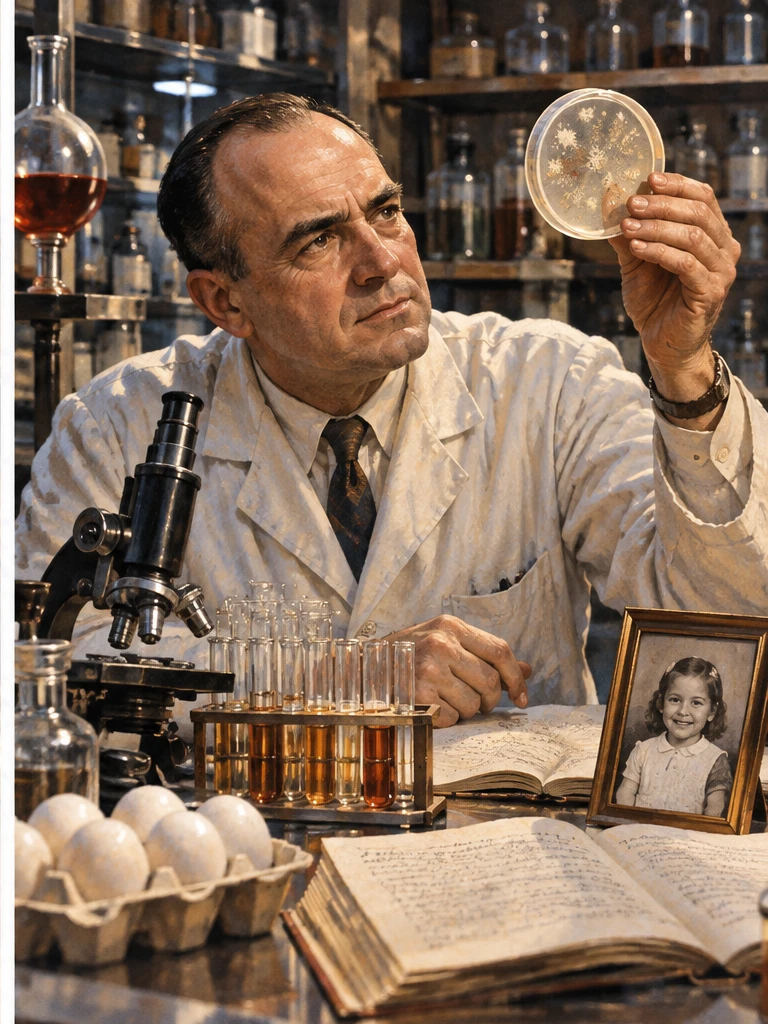
When five-year-old Jeryl Lynn Hilleman developed mumps in 1963, her scientist father collected a sample of the virus. Four years later, a vaccine derived from that strain was licensed. It was one achievement in a career that helped transform childhood medicine.
The night a little girl woke her father
In March 1963, a five-year-old girl in suburban Philadelphia woke her father because she was unwell.
Her name was Jeryl Lynn Hilleman. Her jaw was swollen, and her father recognised the symptoms of mumps.
For most parents, the next step would have been to comfort the child and seek medical advice. Jeryl Lynn's father did that, but he also recognised a scientific opportunity.
Maurice Hilleman was a vaccine researcher at Merck. He knew that a sample of the virus might help his laboratory develop a vaccine against an infection that affected large numbers of children.
He obtained the necessary supplies and took a throat swab from his daughter.
Four years later, a vaccine developed from that virus strain was licensed in the United States. The strain was named Jeryl Lynn.
The little girl's illness had become part of a remarkable public-health story.
But the man behind it remains far less famous than many of the discoveries he helped make.
From a Montana farm to the laboratory
Maurice Ralph Hilleman was born in Miles City, Montana, in 1919. His mother died shortly after his birth, and he grew up in a farming family during difficult economic years.
His early life offered little indication that he would become one of the twentieth century's most influential vaccine scientists.
Farm work taught him about animals, practical problem-solving and the discipline of repetitive tasks. Education gave him another direction.
He won a scholarship to Montana State University and studied chemistry and microbiology. He later earned a doctorate at the University of Chicago.
His scientific career developed during a period when infectious diseases still caused enormous suffering. Childhood illnesses now regarded by many as preventable could lead to hospitalisation, permanent injury or death.
Hilleman entered a field in which laboratory discoveries could change everyday family life.
Why mumps was not always harmless
Mumps is a contagious viral infection often associated with swollen salivary glands and a painful jaw.
Many children recover without lasting harm. But the infection can cause serious complications, including meningitis and hearing loss. In some cases, it can affect other organs.
Before routine vaccination, mumps was common in the United States. Outbreaks spread through schools and households, and parents had few ways to prevent infection.
A vaccine could reduce both the number of cases and the complications that occasionally followed.
Hilleman and his colleagues were already familiar with the challenge of producing safe and effective vaccines against viral diseases.
His daughter's illness provided a promising virus sample for the next stage of that work.
A sample with a family name
After collecting Jeryl Lynn's throat sample, Hilleman brought it to the laboratory, where researchers cultivated the virus.
The challenge was to make the virus suitable for use in a vaccine. A live attenuated vaccine contains a weakened form of a pathogen that stimulates an immune response without ordinarily causing the full disease in healthy recipients.
Researchers adapted the mumps virus through laboratory cultivation. This was not a simple matter of putting an untreated swab into an injection. It required years of experimental work, careful testing and evaluation.
The resulting vaccine strain retained the name of the child from whom the original virus had been collected: Jeryl Lynn.
The name became an unusual bridge between a family episode and a major medical advance.
The younger sister and the trial
Hilleman's younger daughter, Kirsten, also became part of the story. She received the experimental mumps vaccine derived from her sister's strain during its development.
A well-known photograph from the period shows Kirsten being vaccinated while Jeryl Lynn stands nearby. The image has become a striking symbol of the family connection to the research.
Yet a photograph of one child receiving a vaccine cannot establish that the vaccine is safe or effective for a population.
That required systematic clinical studies.
In 1967, Hilleman and colleagues published findings on the live attenuated mumps vaccine in the New England Journal of Medicine. Another study in Pediatrics reported results from a paediatric outpatient setting. Compare this with Eunice Foote’s greenhouse experiment and Rebecca Lee Crumpler’s medical career.
These papers remind us that the breakthrough was not a private experiment conducted by one brilliant father. It was the work of scientists, clinicians, nurses, families and trial participants.
From the laboratory to children's lives
The Jeryl Lynn mumps vaccine was licensed in 1967.
In 1971, the measles, mumps and rubella vaccines were combined into the MMR vaccine, a development associated with Hilleman's team.
The combination made it easier to protect children against three viral infections through a coordinated vaccination schedule.
Mumps cases fell dramatically as vaccination became routine, although outbreaks can still occur and protection is not absolute.
The Jeryl Lynn strain and related derivatives have been used in mumps vaccines for decades.
What began with a child's swollen jaw became a contribution to public health extending far beyond one household.
The scientist behind more than one vaccine
The mumps story is compelling because it has a clear beginning: a sick daughter, a swab and a father's scientific insight.
But it represents only one part of Hilleman's career.
He contributed to vaccines against several major infectious diseases, including measles, rubella, hepatitis B, hepatitis A and chickenpox. His research also addressed influenza and other infections.
Not every vaccine associated with Hilleman was invented by him alone, and different products emerged from different teams, institutions and decades of research.
His importance lay partly in his ability to turn microbiological knowledge into practical, scalable vaccines.
He understood that a discovery in a laboratory was only the beginning. A vaccine had to be developed, tested, manufactured and delivered before it could protect people.
His career linked scientific curiosity with the demanding realities of public-health implementation.
The influenza warning
Earlier in his career, Hilleman studied influenza viruses and recognised that they change over time.
This helped explain why previous infection or vaccination does not always provide lasting protection against new influenza strains. Another angle on science and how discoveries get credited comes from Alice Ball’s leprosy treatment.
In 1957, when a new influenza strain emerged, Hilleman was among the scientists who recognised the threat and pressed for vaccine production.
His work contributed to the response to the pandemic.
It is another example of the kind of contribution that rarely produces a household name but can shape the experience of millions.
A scientist's most important achievement may be something that does not happen: an infection prevented, a hospital admission avoided or a child spared a complication.
Why isn't Maurice Hilleman more famous?
Names such as Louis Pasteur and Jonas Salk became part of the public history of medicine.
Hilleman never achieved the same level of popular recognition, despite his enormous contribution.
There are several reasons. Much of his work took place within industrial research laboratories rather than in a single celebrated public campaign. Vaccine development was collaborative, with achievements spread across numerous diseases and decades.
Hilleman also had a reputation for being demanding and outspoken. Colleagues admired his scientific ability, even when they found his manner difficult.
He was not an uncomplicated saintly figure. He was a driven researcher working in a complex industry, where scientific ambition, commercial decisions and public needs could collide.
That makes his achievements more human, not less.
What can we really say about lives saved?
Articles about Hilleman sometimes attach enormous numerical estimates to his work, including claims about millions of lives saved every year.
Vaccination programmes undoubtedly prevent substantial illness and death, but assigning a precise number of saved lives to one individual is difficult.
Outcomes depend on researchers, manufacturers, clinicians, health agencies, public funding and communities accepting vaccination.
The most defensible conclusion is that Hilleman's contributions helped make several widely used vaccines possible and that those vaccines have had immense public-health benefits.
His legacy is collective as well as personal.
A family story that became a world story
Maurice Hilleman died in 2005, aged eighty-five.
By then, generations of children had received vaccines associated with his research. Many parents who benefited from those vaccines never knew his name.
Jeryl Lynn's name, however, remained embedded in the scientific history of mumps vaccination.
It is a rare and moving detail: a childhood illness preserved not as a family tragedy, but as the name of a vaccine strain used to protect others.
The story is not that a father cured his daughter by inventing a vaccine overnight. Jeryl Lynn recovered from her illness, while the scientific work continued for years.
The true achievement was larger and slower. A moment of parental concern became a research opportunity. A laboratory team turned that opportunity into a tested vaccine. Public-health programmes then carried the protection into homes far beyond Philadelphia.
Maurice Hilleman's legacy is written in the lives of children who never had to experience the illnesses he spent his career trying to prevent.
What the evidence tells us
WELL SUPPORTED: Hilleman collected a mumps virus sample from his five-year-old daughter Jeryl Lynn in 1963.
WELL SUPPORTED: A live attenuated vaccine derived from the Jeryl Lynn strain was licensed in 1967.
WELL SUPPORTED: The MMR combination vaccine was licensed in 1971; Hilleman's work contributed to its development.
WELL SUPPORTED: Hilleman made major contributions to several other vaccines and influenza research.
IMPORTANT CONTEXT: Vaccine development involved research teams, clinical investigators and trial participants; it was not the achievement of one person acting alone.
COMMON MISCONCEPTION: The vaccine cured Jeryl Lynn's mumps. Her illness provided the original viral sample; the vaccine was developed later to prevent infection in others.
REQUIRES QUALIFICATION: Precise numbers of lives saved cannot be attributed exclusively to Hilleman without explaining the modelling and the role of vaccination programmes.
Historical sources and further reading
- Children's Hospital of Philadelphia — MMR Diseases and Vaccines
- Children's Hospital of Philadelphia — Vaccine History, Scientists in Memoriam
- Hilleman et al., Live, Attenuated Mumps-Virus Vaccine. IV. Protective Efficacy as Measured in a Field Evaluation, New England Journal of Medicine (1967)
- Smithsonian National Museum of American History — Measles, Mumps, and Rubella Vaccines
- Gavi — Mumps: The Story of the Second Fastest Vaccine Ever Developed
- National Library of Medicine / PubMed Central — Maurice Hilleman: Creator of Vaccines That Changed the World
Last checked: 25 November 2026.