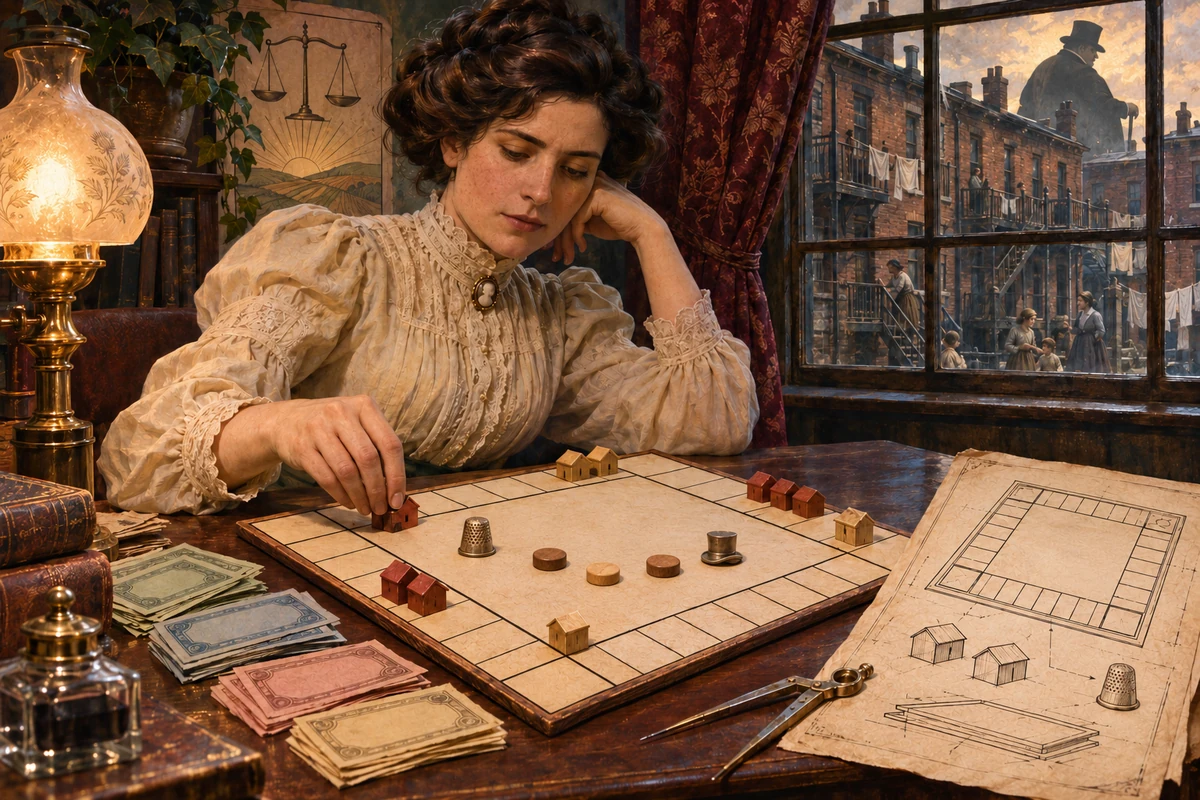
Someone has bought the property you need. Someone else is counting your rent. Before long, a family game has become a small demonstration of what happens when other people own everywhere you might land. One of Monopoly’s ancestors was designed to make players think about precisely that problem.
The short answer
Monopoly developed from an earlier game created by Elizabeth “Lizzie” Magie, who wanted players to understand the economic advantages enjoyed by landowners. She called it The Landlord’s Game. Its history runs through patents, adaptations and a commercial success that made Charles Darrow famous. The familiar game preserves much of the machinery of Magie’s lesson, even when players have never heard of its purpose.
Before the little green houses
On 23 March 1903, Lizzie J. Magie applied for a patent for a game board. It was granted on 5 January 1904 as US patent 748,626. Those dates matter because Monopoly’s widely publicised commercial breakthrough came more than thirty years later.
Her board already has a remarkably familiar look. Players travel around its edge, acquire property and pay rent. There are railroads, mortgages and a jail. Passing the starting point brings wages. A player who cannot meet expenses and has nothing left to borrow against goes to the poorhouse.
Even the arguments have a place in the document. The rules provide for emergencies that players must settle among themselves. An outright refusal to obey the rules can send a player to jail. Family evenings have evidently needed arbitration for some time.
What Magie wanted players to notice
Magie was interested in the ideas of the nineteenth-century economist Henry George. As the Smithsonian’s Lemelson Center explains, she used a board game to introduce his proposals to friends and colleagues. George’s land-value-tax theory offered a way to address the advantage that ownership of land could confer.
Magie continued developing her invention. In 1924, now using her married name Elizabeth Magie Phillips, she received another patent. Its opening explains that the game was meant to entertain while showing how the existing system favoured landlords and how a single tax could discourage speculation in land.
That makes the economic intention unusually easy to establish. We have the inventor describing it in the document for her own game.
Winning was part of the demonstration
There is a complication in the pleasing claim that Monopoly began as an attack on the very thing players enjoy doing. Magie’s patented games themselves include competitive accumulation. The 1904 rules award victory to the player with the greatest total wealth. The 1924 version sets a cash target.
It would therefore simplify the evidence to imagine a wholly cooperative game suddenly transformed into a contest by somebody else. Her invention could let players experience the advantages and frustrations she wanted them to examine. Compare this with the story about Franklin and the turkey.
The later patent includes buying improvements, collecting extra rent and gaining a monopoly in utilities. Players could enjoy making money while taking part in an intended economic lesson. Whether they learned the lesson Magie hoped for was another matter.
How Darrow became the familiar name
The Smithsonian’s National Museum of American History traces the commercial Monopoly to a modified version of The Landlord’s Game. Darrow sold his rights to Parker Brothers in 1935, and the game quickly became a substantial success.
The often-repeated invention story centred on Darrow, an unemployed man who devised a game during the Depression and found his way to prosperity. It was an appealing narrative to attach to a product about getting rich.
Research by Mary Pilon, published in Smithsonian Magazine, follows a longer development involving Magie and people who circulated and altered the game. Her account places the familiar Darrow story within that larger history. Monopoly had ancestors and a community of players before its best-known commercial edition reached the shops.
The woman behind the board
Parker Brothers acquired Magie’s patent for $500, according to the Smithsonian’s account of her overlooked contribution. Darrow became wealthy through Monopoly. Magie’s name was far less familiar to the generations who played it.
Remembering her restores both an inventor and an intention. A game about property can carry a story about who receives credit for creating something valuable.
What the evidence actually says
WELL SUPPORTED applies to Magie’s authorship of The Landlord’s Game, its educational purpose and its relationship to Monopoly. The patents survive, and museum research documents the connection.
The modern game emerged through adaptation. Calling Magie its sole designer in every detail would overlook that process. Her own words establish a particularly important part of its ancestry, and they make the familiar board worth looking at again.
Why the lesson is easy to miss
A successful move gives immediate satisfaction. An economic theory asks for reflection afterwards. Once everyone is calculating rent, the experience can fill the evening without anybody discussing the assumptions beneath it. Other stories about historic spectacles, objects and performers include Sarah Biffin’s career in miniature portraits and Tipu Sultan’s mechanical tiger.
Magie wanted players to notice what ownership did to the people moving around her board. Next time someone in your family owns nearly everything, you will have a historical reason to pause before congratulating them.
Sources and further reading
- Lizzie J. Magie — US patent 748,626, granted 5 January 1904
- Elizabeth Magie Phillips — US patent 1,509,312, granted 23 September 1924
- Smithsonian Lemelson Center — The Woman Inventor Behind Monopoly
- National Museum of American History — Playing Monopoly and Its Discontents on Its 80th Anniversary
- Mary Pilon, Smithsonian Magazine — Monopoly Was Designed to Teach the 99% About Income Inequality
- Smithsonian Magazine — A New Monopoly Celebrates Women, but What About the Game’s Own Overlooked Inventor?