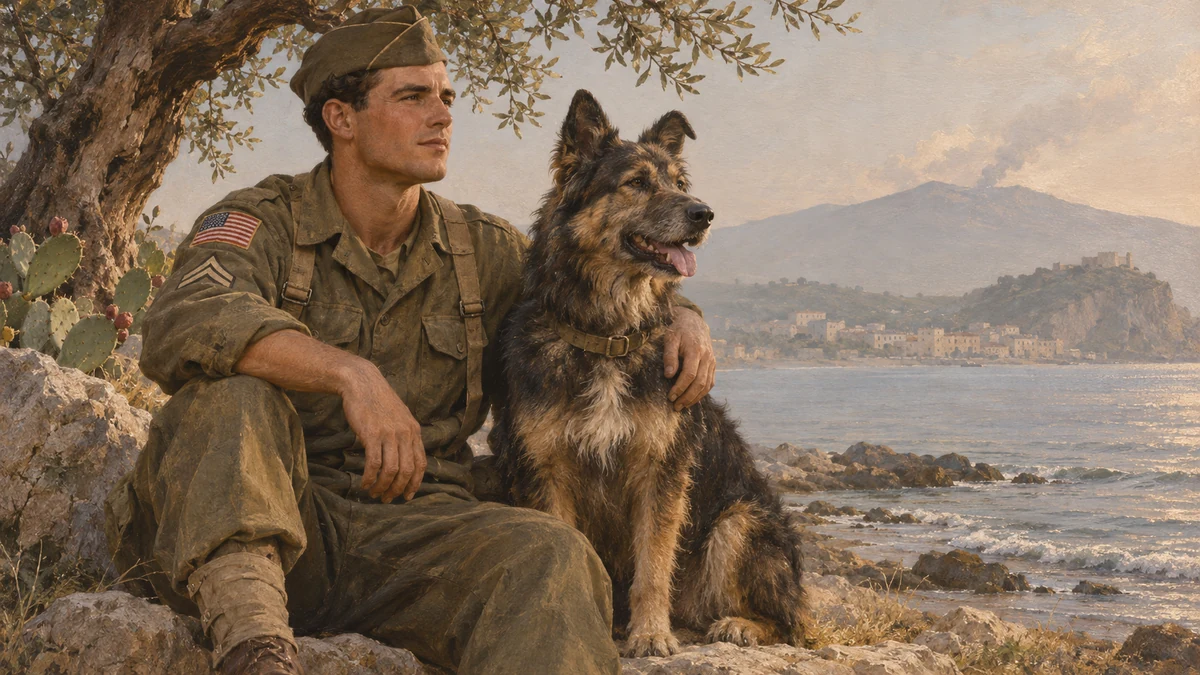
In 1942, a New York family gave the US Army a dog with a reputation for chasing the rubbish collectors. In Sicily the following year, Chips helped stop a machine-gun crew. The Army took back his decorations. A British charity honoured him in its own right 75 years after the events that made him famous.
A problem dog in Pleasantville
Chips belonged to Edward J. Wren and his family in Pleasantville, New York. He was born around 1940, and the Army describes him as a mix of German shepherd, collie and husky. John Wren, who was a small boy during the war, remembered a dog who barked at the postman and chased the rubbish collectors. Some accounts say he bit one of them and that this helped persuade the family to part with him.
The decision was harder than that story makes it sound. John later recalled how painful it was for his mother to give Chips up. In 1942, Dogs for Defense was asking Americans to offer their pets for military service. The Wrens put Chips forward, and the Army sent him to its war dog training centre at Front Royal, Virginia.
From a family pet to a sentry
Chips learned guard work and was paired with Private John Rowell. A sentry dog could pick up sounds and scents his handler missed. The two worked as a team, with the dog alerting the man to someone approaching. Chips joined the 3rd Infantry Division in October 1942 and went overseas with it.
He served in North Africa and was part of the security detail at the Casablanca Conference in January 1943. Franklin D. Roosevelt and Winston Churchill were there to plan the next phase of the Allied war. The dog who had chased delivery men in Pleasantville was now on sentry duty at a meeting between a president and a prime minister.
The landing in Sicily
On 10 July 1943, Chips and Rowell landed with the 3rd Infantry Division near Licata, on Sicily’s southern coast. Fire from a concealed Italian machine-gun position pinned down the Americans. Chips broke away and ran towards the position. The firing stopped.
Rowell recalled seeing a soldier emerge with Chips holding on to him. He called the dog off, and other members of the crew came out and surrendered. The Army and PDSA accounts give four men in all, though some retellings give five. Chips had a scalp wound and powder burns. The Army also recounts a report that he alerted Rowell to ten Italian soldiers approaching the American camp that night. The later encounter is less firmly documented than the one on the beach.
Medals for a dog
On 9 September 1943, Captain Edward G. Parr signed a recommendation for Chips to receive the Distinguished Service Cross, the Army’s second-highest decoration for valour. Major General Lucian Truscott, the division commander, backed recognition for the dog despite a War Department rule against decorating animals. PDSA dates the presentation of the Silver Star to 19 November. Accounts also describe a Purple Heart for Chips’s wounds.
The Distinguished Service Cross has a less certain history. A contemporary newspaper report treated it as a recommendation that the Army could not grant. Later accounts, including the division’s modern history, list it among the medals Chips received and lost. The recommendation is documented. Whether the cross was formally awarded remains disputed.
The Military Order of the Purple Heart objected to giving a medal intended for wounded service members to a dog. The Army rescinded his decorations. His platoon reportedly found a way to recognise him on its own terms, giving him a theatre ribbon with an arrowhead for the assault landing and eight battle stars for his campaigns.
Did he bite Eisenhower?
The best-known story from Chips’s time in Italy has General Dwight D. Eisenhower bending to pat him after the fighting at Salerno and getting bitten for his trouble. The US Army’s own account calls it a rumour. It endured because it sounded like the dog people thought they knew. That is as much as the evidence allows.
Back to Pleasantville
Chips stayed with the division through campaigns in Italy, France and Germany. The Army discharged him on 10 December 1945 and he went back to the Wrens. By then reporters wanted a photograph. John Wren remembered that the family was simply glad to have its dog back. Another angle on wartime ingenuity and remembrance comes from wartime escape maps hidden in playing cards.
Chips died in Pleasantville in April 1946, about four months after his discharge. His story reached a new audience in 1990 when Disney broadcast the television film Chips, the War Dog.
A medal made for animals
The author Robin Hutton came across Chips’s story and nominated him for the PDSA Dickin Medal. The British veterinary charity created the award in 1943 to recognise animals for bravery or devotion to duty. It is often called the animals’ Victoria Cross.
PDSA presented the medal on 15 January 2018 at the Churchill War Rooms in London, 75 years after the Casablanca Conference Chips had helped guard. US Army attaché Lieutenant Colonel Alan Throop received it on Chips’s behalf alongside a serving military working dog named Ayron. John Wren, by then 76, came from New York to see it.
Chips also received the American Animals in War and Peace Medal of Bravery in 2019. In April 2022, the Dickin Medal joined the permanent collection of the 3rd Infantry Division Museum at Fort Stewart, Georgia. The bronze carries the words “We also serve”. The soldiers who gave Chips their own ribbon had found a way to say much the same thing. Compare this with the wartime history of Keep Calm and Carry On and the American fighter pilot who found freedom in France.
Sources & further reading
- PDSA, Chips’s Dickin Medal and the presentation at the Churchill War Rooms
- US Army, “The Dog Hero of the 3rd Infantry Division”
- National Library of New Zealand, contemporary newspaper report on the recommended Distinguished Service Cross
- The Washington Post, John Wren’s recollections
- National Constitution Center, the Purple Heart controversy
- EBSCO, “Chips the War Dog”
- Michael G. Lemish, War Dogs: A History of Loyalty and Heroism