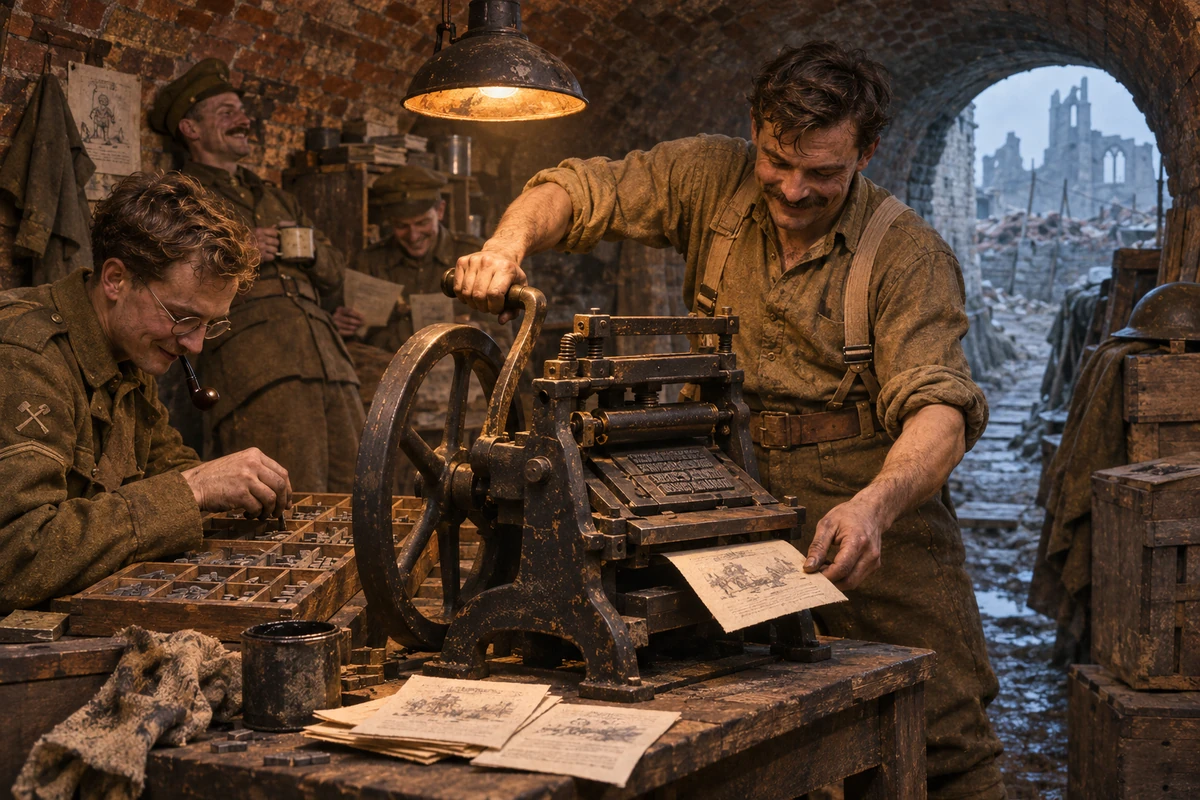
In February 1916, a newspaper in Ypres offered businessmen a stay at the Hotel des Ramparts. The city had been heavily shelled. The hotel’s promise of freshly refurbished rooms was a joke its readers could check by looking outside.
The short answer
Captain Fred Roberts and Lieutenant Jack Pearson of the 12th Battalion, Sherwood Foresters, turned a damaged printing press into a newspaper for men serving on the Western Front. They called it The Wipers Times, after the British soldiers’ pronunciation of Ypres. Fake adverts, send-ups of war correspondents and jokes about daily life gave the men something they could read aloud and pass around. The surviving issues reveal what made them laugh. Why they thought the work worth doing is best understood through the paper itself.
A press in the rubble
The 12th Sherwood Foresters were a pioneer battalion. Their work included repairing trenches and making shelter for other troops. An abandoned press in a shelled city offered a different sort of job. A sergeant who had been a printer in civilian life got the machine working. The regimental museum identifies him as George Turner, though other accounts leave him unnamed. Roberts took the editor’s chair, such as it was, and Pearson became his sub-editor.
The first issue appeared on 12 February 1916. The National Army Museum gives its print run as 100 copies, which were quickly taken up by the men. With limited type, the printers could set only a page at a time. Later accounts describe a shortage of e’s and y’s. There was also the question of what the censor would allow. In the opening editorial, the editors promised to refer cautiously to the war, “which we hear is taking place in Europe”.
Printing had to fit around the battalion’s duties and the shelling. David Tyler’s account for AM, drawing on Roberts’s recollections, describes a shell hitting the press before the third number was finished. A smaller hand press and more type were found near Hellfire Corner, the notorious crossroads on the road to Hooge. Whatever the precise sequence of repairs and replacements, a third issue survives, dated 6 March 1916.
First-class rooms in a shattered city
The first front page paired its hotel advertisement with a notice from the fictitious Wipers, Fish-Hook and Menin Railway. The notice announced that trains would go no farther than Gordon Farm, a position near the line, because the route ahead was closed for alterations. The language belonged on a suburban platform. The readers knew what could actually close a route beyond Gordon Farm.
Other issues turned ambulances into supposedly well-appointed taxis and found a boy with an aptitude for mechanics a highly unsuitable present, a flamethrower. Historian Bruno Leal Pastor de Carvalho analysed 157 invented advertisements across the run. Their joke often depended on the gap between a familiar sales pitch and the conditions a soldier could see for himself. Later in the century, escape maps hidden inside playing cards made another clever use of a familiar printed object, with a very different purpose.
Giving the correspondents a turn
Roberts and Pearson also borrowed the voices of people paid to explain the war to civilians. William Beech Thomas of the Daily Mail became Teech Bomas, a correspondent with a weakness for florid battle scenes. Hilaire Belloc became Belary Helloc. In one parody, the writer subtracts casualties, non-combatants and assorted unfit men from Germany’s fighting strength until he has just sixteen men left on the Western Front. The arithmetic is the joke. The certainty with which he delivers it is the target.
The paper could turn a popular fictional detective into Herlock Shomes, send up headquarters in a column asking awkward questions and make space for poems that were sometimes quite serious. Different kinds of wartime writing could have very different afterlives. The legend of the Angels of Mons shows how an imagined battlefield story could be retold as fact. The Hotel des Ramparts joke depended on its readers knowing exactly how much of the advertisement to believe.
A newspaper that moved with its readers
After four issues under its original name, the paper followed the battalion. The “New Church” Times took its title from Neuve Église, where the battalion was posted by April 1916. Next came The Kemmel Times, The Somme Times and The B.E.F. Times. The change to a title that gave away no location was also connected with censorship, according to the National Army Museum.
The series ran to 23 issues. Its final guise was The Better Times. The last number, a Christmas issue in December 1918, is held by the National Army Museum. By then the Armistice had been signed. For once the optimism in the masthead could be read straight.
What the jokes did
A hundred copies were enough to reach far more than a hundred people. The National Army Museum describes copies being passed from hand to hand and parts read aloud in dug-outs and trenches. One man with a sheet of paper could give a whole group the same joke. It mattered, too, that the people making the jokes knew what a flooded trench, a bad patch of road or a cheerfully written dispatch sounded like to the men who had been there.
It is reasonable to see the paper as a way of keeping going and talking back. The evidence is stronger for what the men printed and how the paper was shared than for any single motive. Claims for morale can sit beside another possibility. Roberts and Pearson had found a pastime that let the people who were usually written about do some of the writing themselves.
The editors after the war
Both men survived the war and received the Military Cross. Roberts returned to mining engineering and died in 1964. Pearson died in 1966. The newspaper remained available in collected editions, while the men behind it became less familiar to the public. Much later, a television adaptation by Ian Hislop and Nick Newman aired on BBC Two in 2013. The Times then printed belated obituaries for both editors. As with the wartime story of Chips the Army dog, public recognition arrived on a different timetable from the events themselves.
The front page of that first number is still the best introduction to what they made. With a short supply of type and a city coming apart around them, the men set up an advertisement for a hotel. They knew their readers would understand why.
Related curiosities
- Did Angels Really Appear Above a First World War Battlefield?
- Why Were Escape Maps Hidden Inside Playing Cards?
- The Dog the Army Couldn’t Decorate
Sources & further reading
- The Wipers Times, first issue, 12 February 1916 — facsimile
- National Army Museum — The Wipers Times: The soldiers’ paper
- National Army Museum — The Better Times, final Christmas number, December 1918
- Museum of the Mercian Regiment — The Wipers Times and Sergeant George Turner
- David Tyler, AM — The Wipers Times
- Western Front Association — Hooge in the Wipers Times
- Bruno Leal Pastor de Carvalho, Revista de História — study of the paper’s fictitious advertisements
- Henry Williamson Society — the 1973 facsimile and the editors’ post-war lives
Last checked: 25 November 2026