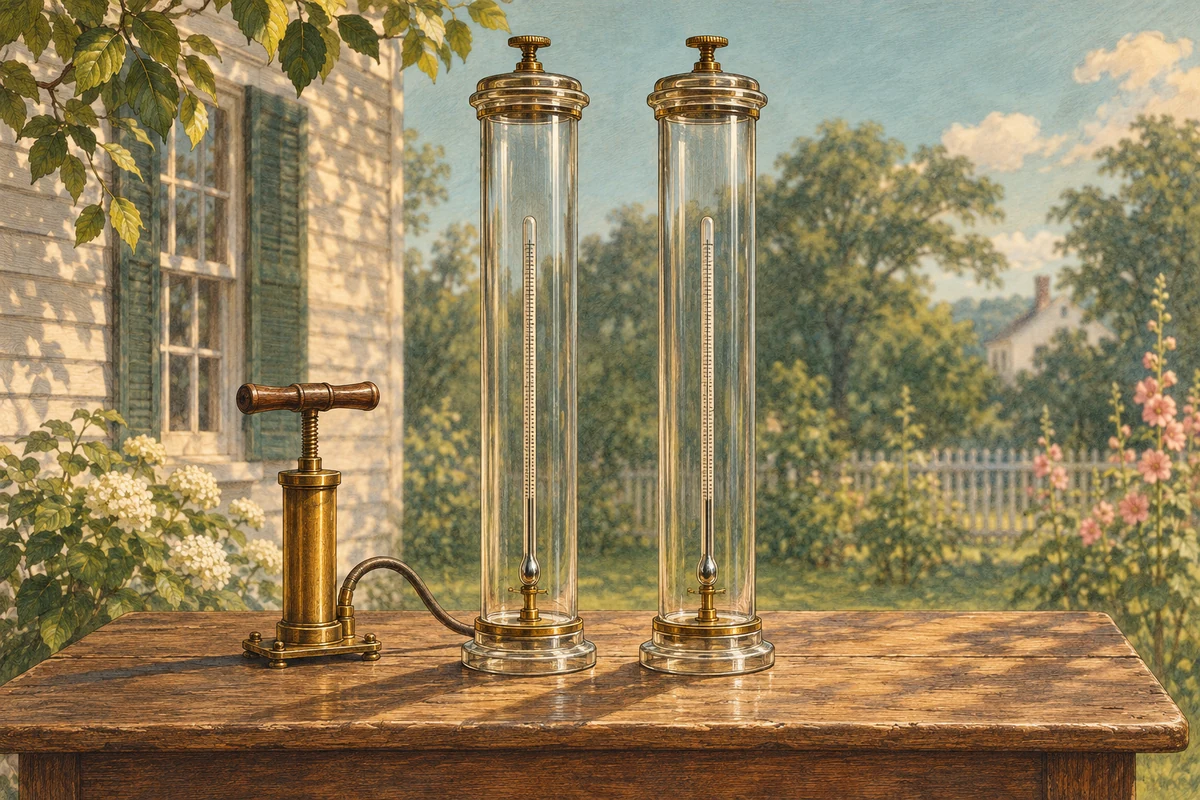
In 1856, Eunice Newton Foote put two glass cylinders in the sun. One grew warmer than the other and took much longer to cool. In that difference, she saw a possible explanation for why the Earth itself had once been warmer.
The short answer
Joseph Fourier argued in the 1820s that the atmosphere helps keep Earth warm. Eunice Newton Foote connected carbon dioxide with a warmer climate in 1856. From 1859, John Tyndall began measuring how gases absorb radiant heat, helping explain how the greenhouse effect works. Each answered a different part of the question.
Two cylinders in the sun
Foote’s equipment was simple enough to describe in a few lines. She had an air pump, two glass cylinders about 30 inches long and four inches across, and two thermometers in each cylinder. She varied what was inside the cylinders, set them side by side in the sunlight and watched the temperatures rise. Moist air warmed more than dry air. The strongest result came when she compared ordinary air with carbon dioxide, which she called carbonic acid gas.
In the comparison she published, the carbon dioxide reached 125°F, about 52°C. The ordinary air reached 106°F, about 41°C. The carbon dioxide cylinder itself became hot and, Foote reported, took much longer to cool once she removed it from the sun.
Then came the leap. “An atmosphere of that gas would give to our earth a high temperature,” she wrote. If the air had once contained more carbon dioxide, she reasoned, the Earth might have been warmer. The experiment occupied two pages in a journal. That sentence took it from a pair of cylinders to the history of a planet.
The paper someone else read
On 23 August 1856, at a meeting of the American Association for the Advancement of Science in Albany, New York, Joseph Henry of the Smithsonian Institution read Foote’s paper on her behalf. Scientific American covered the work that September under the heading “Scientific Ladies”, praising her originality and precision. In November, the American Journal of Science and Arts printed the paper under Foote’s own name. Her work had an audience in 1856. It was in later accounts of climate science that she became easy to miss. Other stories about science and how discoveries get credited include Josephine Cochrane’s dishwasher patent and the patent dispute over Margaret Knight’s invention.
What Tyndall measured
When sunlight warms the ground, the ground gives off energy as infrared radiation. Gases including water vapour and carbon dioxide absorb some of that outgoing radiation and emit infrared radiation in turn, including back towards the surface. This helps keep the surface warmer.
Foote measured how warm the contents of a sunlit cylinder became. Several processes could affect that reading, including the warming of the glass itself. Tyndall’s apparatus let him ask a narrower question: how much radiant heat would pass through a particular gas? He sent radiation from a heat source through a tube and measured what emerged at the far end. His detailed 1861 paper showed that carbon dioxide and water vapour absorbed radiant heat strongly compared with the nitrogen and oxygen that make up most of the air. Related examples can be found in the forest planted one tree at a time.
Why one name stuck
Tyndall’s measurements gave later scientists a way to explain the effect, and his name became closely associated with its discovery. Whether he ever saw Foote’s paper remains open. The surviving record contains no direct evidence that he read it, and historians differ over how likely he was to have encountered it.
Foote had some recognition among historians of science before a fresh wave of attention followed Ray Sorenson’s 2011 account of her work. By then, the gas she had called carbonic acid was familiar to anyone following the climate news. What still surprises on reading her paper is how quickly she moved from watching a thermometer to asking what a different atmosphere might do to the whole Earth.
Related curiosities
How Did a Snowy Tram Ride Give Cars the Windscreen Wiper?
Was Monopoly Created to Warn Us About Landlords?
The Blind Woman Who Travelled to Tibet to Teach Children the World Had Forgotten
Sources & further reading
- Eunice Foote, Circumstances Affecting the Heat of the Sun’s Rays (1856), reproduced by the Smithsonian Science Education Center
- John Tyndall, On the Absorption and Radiation of Heat by Gases and Vapours (1861)
- Roland Jackson, Eunice Foote, John Tyndall and a Question of Priority
- American Physical Society, Eunice Foote Concludes That Carbon Dioxide Could Warm the Atmosphere
- MIT, Climate Science, Risk & Solutions
Last checked: 25 November 2026.