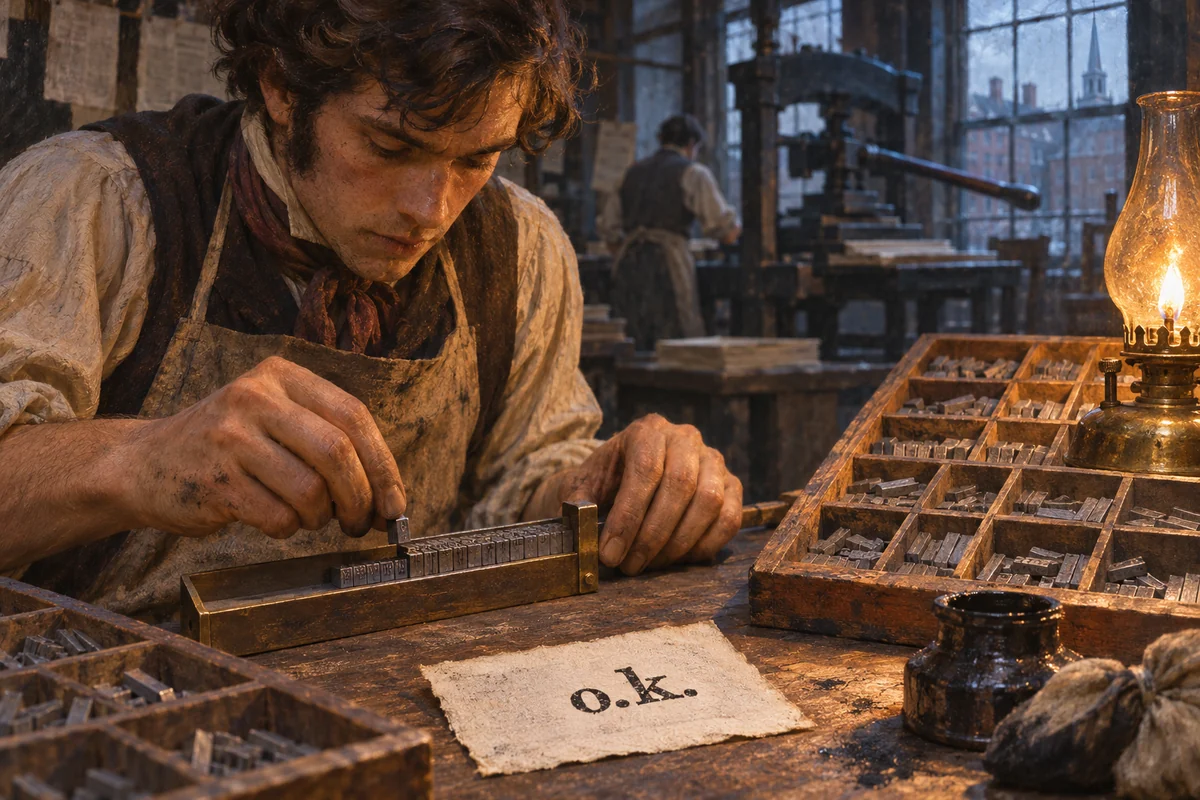
Two letters can approve a plan, answer a question or bring a conversation to an end. In 1839, a Boston newspaper used them for something rather different. “O.K.” was a little joke that depended on readers knowing how to spell the words it stood for.
The short answer
The best-supported origin of “OK” is “oll korrect”, a deliberate misspelling of “all correct”. On 23 March 1839, the Boston Morning Post printed “o.k.” and helpfully explained it as “all correct”. The following year, supporters of Martin Van Buren used the same initials for “Old Kinderhook”, his nickname. The campaign gave an existing expression a second meaning and a wider audience.
The newspaper fad that made a mistake funny
Boston newspapers of the late 1830s played with initials. The joke was sometimes to misspell a familiar phrase and then abbreviate the misspelling. You could write “O.W.” for “oll wright”, meaning “all right”, or “K.G.” for “know good”, meaning “no good”. Spelling supplied the punchline.
In the Boston Morning Post, editor Charles Gordon Greene used “o.k.” in a short item ribbing a Providence newspaper over a story about a Boston group calling itself the Anti-Bell-Ringing Society. The subject of the item is obscure today. The helpful part is the explanation printed beside the initials. A reader in 1839 could see at once that “o.k.” was being used for “all correct”, even though the usual spelling of those words would give you A.C.
Linguist Allen Walker Read found that example while tracing the history of the expression. He presented his research in a series of articles in American Speech in the 1960s. The newspaper tells us that the joke was in print on that date. It leaves open how many people might already have been saying it.
How “OK” became a campaign slogan
Martin Van Buren was born in Kinderhook, New York. During his 1840 campaign for a second term as president, supporters used his nickname, “Old Kinderhook”, and organised under the initials O.K.
It was a handy piece of political wordplay. The initials identified the candidate and, in their older sense, implied that all was correct with him. Opponents could play with the initials too, and the expression reached readers who had never seen the Boston joke.
Van Buren lost the election to William Henry Harrison. The letters survived the result. “OK” could go back to doing an ordinary job in ordinary conversation, now with many more people familiar with it.
The story everyone tells
“Old Kinderhook” is often given as the whole explanation. It has a genuine place in the history, and a presidential campaign is easier to remember than a brief item about a bell-ringing dispute. The dates settle the order. The Post example appeared in March 1839 and supplied “all correct” as the meaning. Van Buren’s supporters used the initials in the following year’s campaign.
Another proposed connection is the Choctaw word okeh, used to affirm or agree. That resemblance is intriguing, but a similar sound and meaning alone cannot establish how the English expression entered use. The Boston example has the advantage of appearing alongside a fad that explains both its odd spelling and its abbreviated form. Related examples can be found in the Greek god behind the word panic.
What the evidence actually says
The 1839 newspaper and the 1840 campaign records support two distinct steps. The first establishes the joke in print. The second shows the initials being taken up and repurposed on a larger stage. There may have been earlier spoken uses, and no surviving newspaper can prove who first made the joke. The link between the printed initials and “all correct”, however, is unusually explicit for a saying we still use.
The later spelling “okay” makes sense once the initials are spoken as the names of two letters. It gives us a word we can read straight through and use in sentences such as “She okayed the changes.”
Why it stuck
Most of the newspaper’s joking abbreviations stayed jokes. “OK” had work to do. It could say that something had been checked, that a proposal had been accepted or that a message had been received. It could also express a more modest judgement. An OK meal and an excellent meal are rarely the same thing. Other stories about the language of old trades and social life include the fox fable behind sour grapes and the cold-meat story about giving someone the cold shoulder.
Tone supplies still more meanings. An enthusiastic “OK!” can launch a plan. A hesitant “OK…” can leave a plan hanging. Once you know the word, it takes only two letters to say a surprising amount, and sometimes just two to say that you’ve heard enough.
Related curiosities
Did “Mind Your P’s and Q’s” Really Come From Drinking Punch?
Why Do We Say “Bob’s Your Uncle”?
Where Did “Spill the Beans” Come From?
Sources & further reading
- Allan Metcalf, Oxford University Press — Happy Birthday OK
- Dave Wilton, Wordorigins.org — OK / okay / A-OK, with a transcription of the 1839 newspaper item
- History — How “OK” Became America’s Favorite Word
- The New Yorker — At Play in the Language, a profile of Allen Walker Read and his research
- State Historical Society of Missouri — Allen Walker Read Papers, including his “OK” research files
- U.S. National Park Service — Martin Van Buren and the Politics of Slavery, including the 1840 election result
Last checked: 25 November 2026.