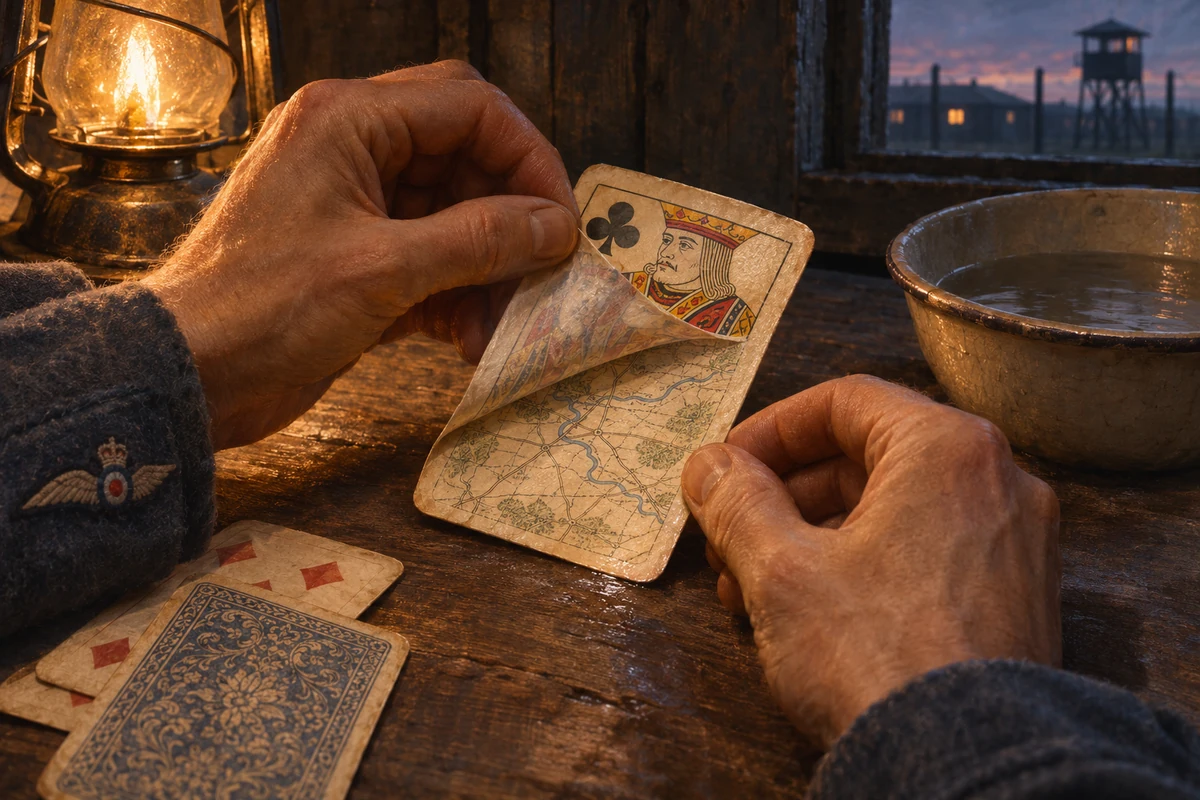
A pack of cards could fill an evening in a prisoner-of-war camp. Certain wartime packs offered another possibility. Beneath the familiar faces lay pieces of a map, waiting for someone who knew how to separate them.
The short answer
During the Second World War, specially prepared playing cards concealed maps intended to help Allied prisoners plan escapes from German camps. Map sections were hidden between layers of paper. With some designs, wetting the cards allowed the layers to be peeled apart and the pieces assembled. Surviving examples in museum collections confirm the technique. Other stories about wartime ingenuity and remembrance include the wartime history of Keep Calm and Carry On and the legend of the Angels of Mons.
A route beyond the wire
Getting out of a camp was only the beginning of an escape. Once outside, a prisoner needed to work out where to go. An unfamiliar road, railway or frontier could make the difference between progress and recapture.
The RAF Museum explains that reliable maps were essential to planning possible routes. Its collection includes an incomplete set of 29 playing cards, with concealed maps in the ten of spades and jack of clubs. The museum’s object reference is 72/S/438.
Those small surviving objects give this story a particularly solid foundation. We can examine the kind of equipment that prisoners were meant to use, rather than relying entirely on later recollections of an ingenious scheme.
Why choose a pack of cards?
Cards belonged among the ordinary comforts of camp life. A pack could be played with, handled and put away without immediately announcing that it contained military information.
That familiarity made it useful camouflage. Someone inspecting a parcel might recognise the object and move on. Someone instructed in its secret purpose could look beyond the surface.
A separate example at the International Spy Museum is dated 1944. Its ace of spades conceals a section of map that is revealed when the card is soaked in water. The museum connects the deck with cooperation between the US Playing Card Company and American and British intelligence agencies.
A single card supplied only part of the picture. Other cards were needed to reconstruct the map.
The map beneath the face
The US National Park Service describes how the concealed-map decks worked. Water loosened the layers of paper so that the cards could be separated. The hidden sections then had to be arranged in order.
It was a small act of destruction with a practical purpose. A card that had been useful for a game became a fragment of geographical information. Its value depended on the other pieces surviving and on someone knowing what to do with them.
The RAF Museum’s display describes sections hidden behind removable card faces. Museum accounts cover different surviving objects and designs, so it would be misleading to imagine that every wartime escape pack had precisely the same construction. Related examples can be found in the RAF expression gone for a Burton.
A much larger world of disguised objects
The cards belonged to a broader effort to help servicemen evade capture and escape imprisonment. Britain established MI9 in 1939. National Museums Scotland describes its work with maps, concealed equipment and manufacturers able to turn everyday objects into hiding places.
Maps could be printed on fabric for concealment in clothing. Games and gramophone records could carry hidden items. The Edinburgh mapmakers John Bartholomew & Sons supplied mapping material, while firms including John Waddington & Co assisted the escape programme.
Getting equipment into a camp required organisation as well as inventive packaging. National Museums Scotland records that MI9 used bogus charities, including the Prisoners’ Leisure Hours Fund, to send parcels. Coded correspondence could request equipment and acknowledge that it had arrived.
That detail deserves care. Accounts of humanitarian relief parcels and accounts of covert consignments are often compressed into one colourful story. The evidence for MI9’s use of fictitious charities gives us a specific delivery method without requiring a sweeping claim about Red Cross involvement.
The story everyone tells
The tempting version is a perfect escape scene. A prisoner opens a harmless pack, uncovers a secret route and reaches freedom. It has the neatness of a film sequence.
The objects establish the concealed maps. They do not, by themselves, tell us how many men escaped because of them. The International Spy Museum presents escape totals as something the decks are said to have assisted, while the National Park Service notes uncertainty over how many decks were made.
An account of a successful escape would need its own evidence. For this article, the stronger story is the documented effort to put useful information into a prisoner’s hands through an object a guard might overlook.
What the evidence actually says
WELL SUPPORTED applies to the existence and purpose of the concealed-map cards. Museum collections preserve examples, and institutional accounts describe how their layers could be separated.
The survival of particular cards provides firmer ground than an exact total of successful escapes attributed to the scheme. We can describe the equipment confidently while leaving those totals open.
Why an ordinary object mattered
The ingenuity depended on a habit most of us share. We recognise a familiar object and assume we know what it contains. A pack of cards promises a game.
For the person who knew its second purpose, that same pack could offer roads, borders and the beginnings of a plan. The map had travelled into captivity disguised as something to help pass the time.
Sources and further reading
- RAF Museum — Playing Cards with a Concealed Map
- RAF Museum — Playing Cards with Hidden Maps, object 72/S/438
- International Spy Museum — Bicycle Escape Map Cards
- US National Park Service — Stacking the Deck, Escape Cards of World War II
- National Museums Scotland — Escape and Evade, How to Avoid Capture in the Second World War