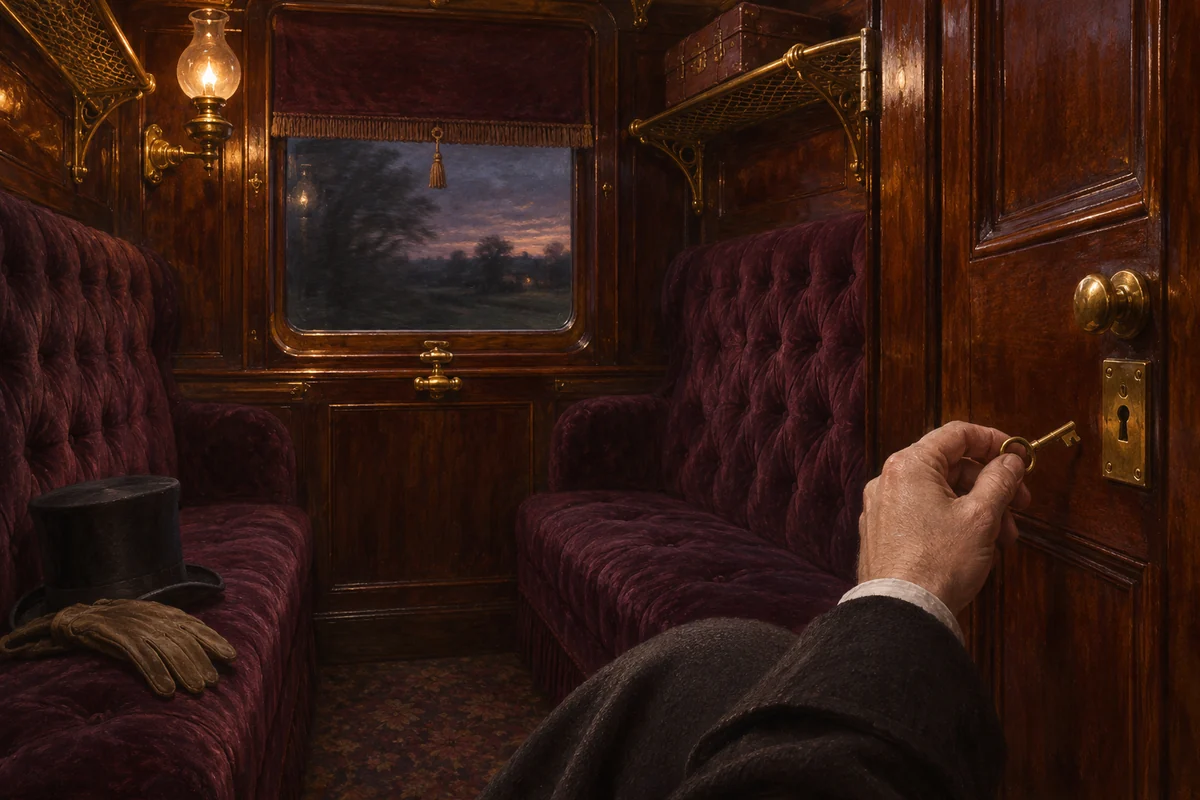
On some Victorian trains, a first-class ticket bought a padded seat and a door the guard might lock from the outside. There was no corridor to walk down if you needed help. A few passengers came equipped with a railway carriage key of their own.
The short answer
Some Victorian passengers carried keys because guards could lock the doors of separate railway compartments between stations. In a carriage without a connecting corridor or a reliable way to call the crew, a key offered a measure of control. The 1864 murder of Thomas Briggs sharpened public concern. In 1868, Parliament required a means of contacting the crew on passenger trains that ran more than 20 miles without stopping. Other stories about leisure and enterprise in the Victorian age include the room covered in postage stamps and Victorian exhibitions of human curiosities.
A private room on wheels
An early railway carriage could be a series of little rooms on a single frame. In the first- and second-class designs described by the National Railway Museum, each compartment had its own doors to the outside and no interior passage to the next one. A guard might lock those doors between stops. Other classes and designs could have more open interiors, so the experience varied according to the ticket and the train.
A compartment could feel agreeably private when everything went well. If a passenger felt ill, feared someone sharing the compartment or worried about an accident, that same arrangement made it difficult to attract attention. A key let its owner unlock a door. It offered no safe way off a moving train and no means of reaching the guard. It solved one part of a larger problem.
The murder that changed how people looked at the door
On 9 July 1864, two passengers joined a North London Railway train at Hackney and found blood in a first-class compartment. Thomas Briggs, a banker who had been travelling on the train, was found grievously injured on the line and later died. Franz Müller, a tailor, was convicted of his murder. The case is generally described as Britain’s first railway murder.
The crime gave an existing fear a particular shape. A stranger could share your compartment without anyone in the next one seeing what happened. As newspapers debated the safety of locked compartments, the carriage key became part of the argument. The National Railway Museum describes an MP, Darby Griffith, producing one during a parliamentary debate and challenging opponents of reform to say whether he could legally use it to escape after an accident.
What happened when you pulled the cord?
Section 22 of the Regulation of Railways Act 1868 required companies, from 1 April 1869, to provide an approved way for passengers to communicate with the crew on trains that travelled more than 20 miles without a stop. The Act specified the result the system had to achieve. It left room for different devices. Compare this with the red flag required for early motor vehicles.
One arrangement used a cord that ran outside the carriages near the roofline and rang a bell in the guard’s van. Pulling it alerted the guard, who then had to act. The system could fail at the moment it was needed. The National Railway Museum recounts an 1871 incident in which a passenger reported repeatedly pulling the cord during a struggle without attracting help before the next station.
What the evidence actually says
The murder made the isolation of railway compartments harder to ignore, but passengers had complained about it before Briggs died. And the new rule did not cover every train. Its distance threshold mattered to anyone travelling on a short or frequently stopping service.
The key and the cord answered different questions. One gave a passenger some control over the door. The other gave the crew a way to hear from people they could neither see nor reach easily between stops. The railway could carry people across the country at unprecedented speed. It took longer to give a person behind a locked door a reliable way to ask for help.
Related curiosities
Why Did Victorians Fear Being Buried Alive?
Why Did Victorian Families Decorate Their Homes with Poison?
Why Did a Mysterious Woman's Photograph Survive 150 Years Beneath the Sea?
Sources & further reading
- National Railway Museum — Carriage Keys and Claustrophobia: Early Railway Compartments
- British Transport Police — The First Railway Murder
- The National Archives — Victorian Railways, including records relating to Thomas Briggs
- UK Parliament — Regulation of Railways Act 1868, section 22
Last checked: 25 November 2026.