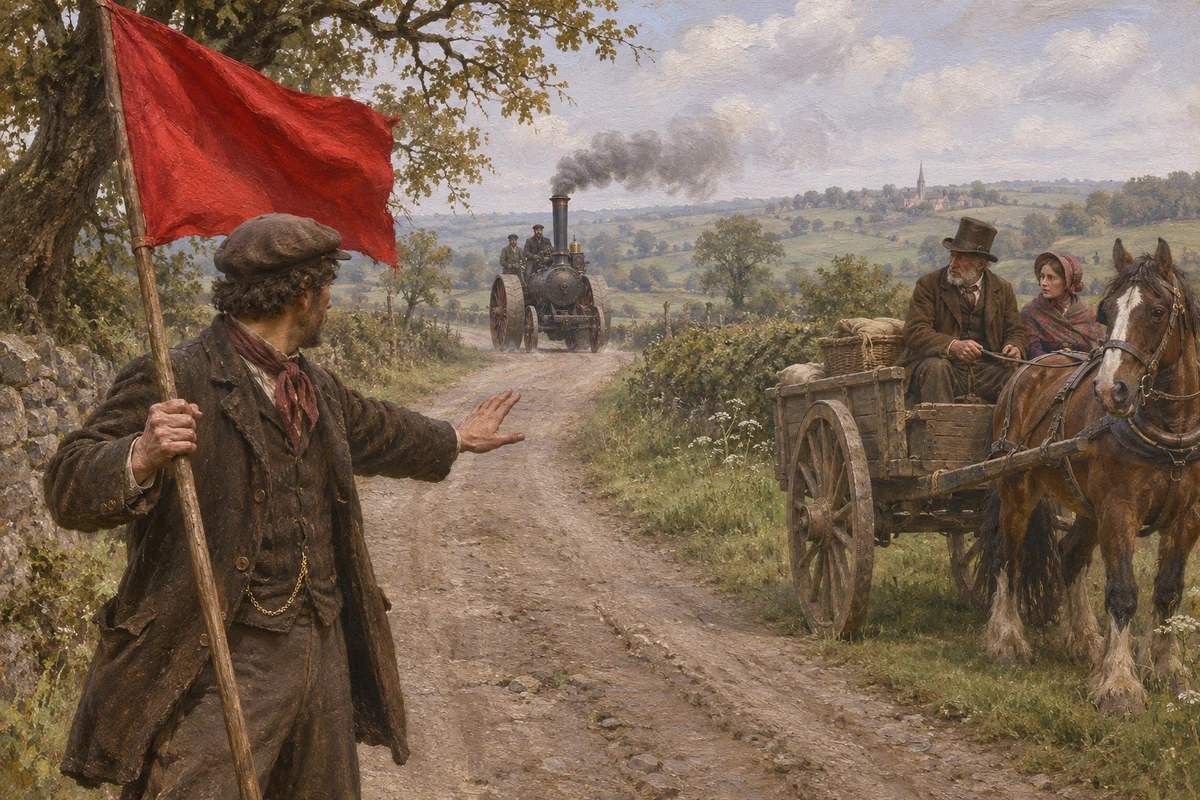
Imagine meeting a man with a red flag on a country road. A horse and cart wait nearby. Behind the man comes a steam engine on iron wheels, travelling without rails. For a time, the man, the flag and the distance between him and the engine were all matters of law.
The short answer
The Locomotives Act of 1865 required a person carrying a red flag to walk at least 60 yards ahead of a moving road locomotive. The warning gave riders and drivers of horse-drawn vehicles time to react. England dropped the flag from that rule in 1878 but kept the walking escort at a shorter distance. In 1896, qualifying light vehicles were exempted from the old restrictions.
The engine the Victorians were trying to control
The usual retelling starts with a motor car, perhaps a small open carriage with a driver in goggles. Start instead with a steam road locomotive. It had a boiler, heavy wheels and machinery built to haul loads on roads shared with horses. The practical question was what happened when both kinds of traffic met on a road with little space to pass. Other stories about early motoring and transport include Britain’s first car number plates and Victorian railway carriage keys.
The 1865 Act required at least three people to operate or conduct a road locomotive. One walked in front, keeping the red flag on display. That person could warn riders, help horse-drawn traffic pass and signal to the engine driver to stop. A person in charge of a horse could also call for an immediate stop by raising a hand.
Parliament even banned sounding the locomotive’s whistle on the road. The engine could be powerful, but the law gave a rider’s raised hand more authority than its whistle.
Two miles an hour through town
The Act set a maximum of four miles an hour on the open road and two through a city, town or village, subject to local rules. The flag was only the most visible part of a system that also controlled speed and required drivers to leave room for other traffic.
In England, Parliament changed the rule in 1878. The person on foot still had to lead the engine, now by at least 20 yards, and assist horse traffic when needed. The new wording dropped the requirement to carry a flag. By the time practical petrol cars began to appear, the English rule could still leave a motorist following a pedestrian. The flag itself had already gone. Related examples can be found in the invention of the windscreen wiper.
What changed in 1896?
The Locomotives on Highways Act created a category of light locomotives and exempted qualifying vehicles from earlier restrictions. The statutory ceiling was 14 miles an hour, with power to prescribe lower limits. A light locomotive still needed an audible warning device, such as a bell. The warning could now travel on the vehicle.
On 14 November 1896, the day the new arrangements came into force, the Motor Car Club celebrated with a drive from London to Brighton. Petrol, steam and electric vehicles took part. According to the National Motor Museum, most of the electric vehicles had to finish the journey by train. For all the talk of emancipation, range was already a practical concern.
What the evidence actually says
The image of a red flag in front of a motor vehicle is real. It belongs most directly to the age of heavy steam road engines. The familiar story compresses three moments into one. Parliament required the flag in 1865, dropped it from the English rule in 1878, and freed qualifying light vehicles from the older escort rules in 1896.
The London-to-Brighton run still celebrates that final change. The detail worth remembering is what the original law expected of a driver. When a horse came the other way and its rider raised a hand, the machine had to wait.
Related curiosities
Why Did a Mysterious Woman's Photograph Survive 150 Years Beneath the Sea?
Why Did Victorian Families Decorate Their Homes with Poison?
What Were Victorian Circus Posters Really Selling?
Sources & further reading
- UK Parliament — Locomotives Act 1865, sections 3–4
- UK Parliament — Highways and Locomotives Amendment Act 1878, section 29
- UK Parliament — Locomotives on Highways Act 1896, sections 1–4
- National Motor Museum — London to Brighton Veteran Car Run
- Royal Automobile Club — History of the Run
Last checked: 25 November 2026.