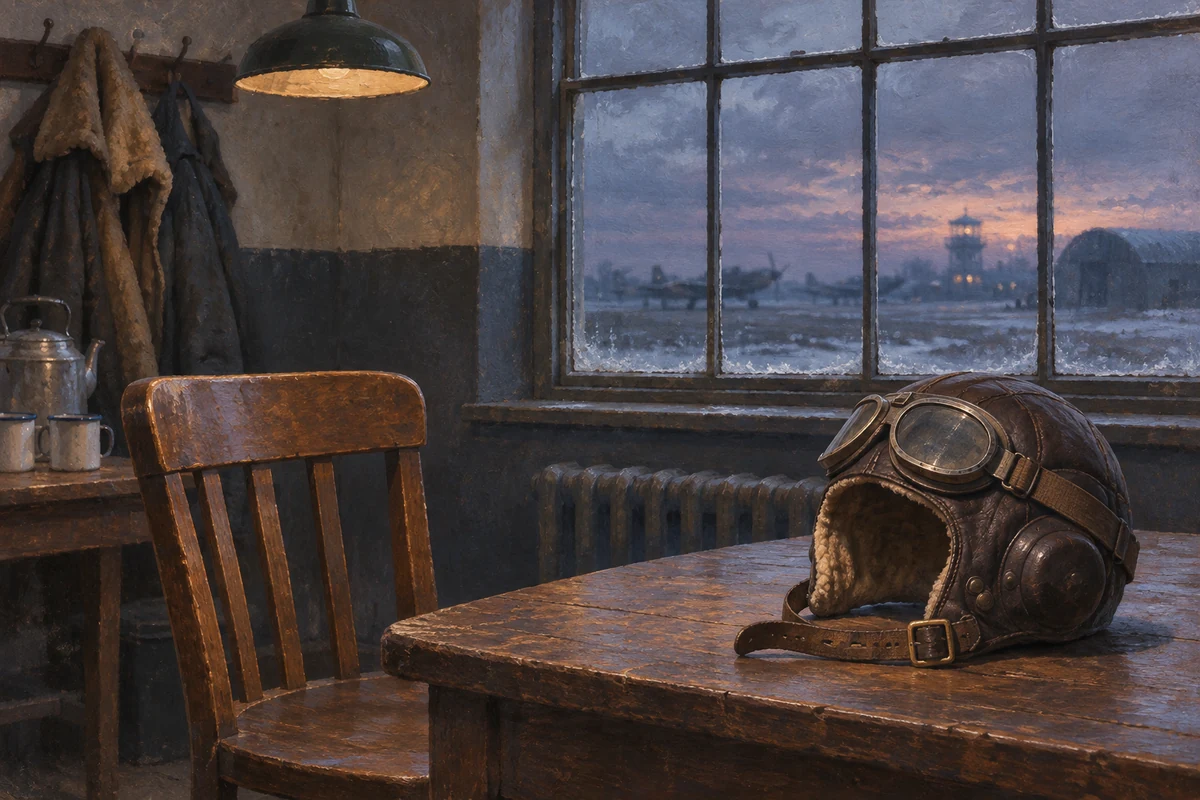
In 1943, an aircraftman writing to an American magazine explained how airmen spoke about a man who had been killed. They could say he had gone for a Burton. The words sounded as though he might be back in time for the next round.
The short answer
During the Second World War, RAF aircrew used “gone for a Burton” when someone had been killed. The expression also came to mean that something was lost, ruined or destroyed. One wartime explanation connects it to Burton ale, from Burton upon Trent in Staffordshire. It is an attractive possibility with a contemporary witness, although the expression’s exact route into RAF speech is still uncertain. Compare this with the wartime history of Keep Calm and Carry On and the legend of the Angels of Mons.
What airmen meant by it
The phrase was in print by August 1941. Michael Quinion’s survey of the early records notes that the New Statesman glossed the expression as “crash”. In March 1942 the Aeronautical Review defined it as being killed in action. These early glosses show what the phrase meant to wartime readers and give us a useful date by which it was already in circulation.
Later in 1942, The Australian Women’s Weekly reported the actor and RAF pilot John Justin’s account of an accident. Justin had hit a tree, crashed his aircraft and been badly injured. Describing what he thought had happened to him, he reached for the phrase himself. His use makes clear how much could be tucked into those few words. Another angle on wartime ingenuity and remembrance comes from the American fighter pilot who found freedom in France.
A letter from Calgary
In April 1943, Leading Aircraftman W. J. L. Gibbons explained the expression in a letter to Time. Writing from Calgary, he described it as something an airman might say about a friend who had been killed. He also applied it to people or things that were finished for good. That broader use was already audible in wartime.
Gibbons said the expression came from a familiar excuse for someone’s absence. If the man was wanted and his whereabouts were unknown, he might have gone to the pub for a Burton beer. Burton upon Trent was an established brewing town, and Burton ales were a familiar enough name to make the explanation work. In the circumstances Gibbons described, a phrase that suggested a short absence could be used for a permanent one.
The advert everyone remembers
A more elaborate version of the beer story credits a pre-war advertising campaign. Picture a group with one obvious gap: a football team a player short, or a table with an empty chair. In the story, the missing person has gone for a Burton, and airmen borrow the line.
Real Burton ale advertisements survive. Quinion reproduces a Marston’s example from 1937. The missing-person campaign with the supposed slogan is a different proposition. His investigation found no trace of it. Gibbons offers contemporary evidence for the beer explanation, but his letter describes a pub-going expression and gives no advertising campaign as its source.
What the evidence actually says
The RAF use is well supported by the early glosses, Justin’s interview and Gibbons’s letter. The link to Burton ale is plausible. Oxford’s learner’s dictionary dates the phrase to the Second World War and treats the connection to the ale as a possibility. The letter shows that an aircraftman was already making that connection in 1943. It cannot establish where he heard it or how the phrase first entered service slang.
Why it lasted
The expression offered a way to mention an absence without saying the hardest part aloud. Its wider meaning also worked for smaller everyday disasters. A tool could be lost, a plan could collapse or a machine could give up for good. Today the dictionary gives the expression as old-fashioned British slang. The wartime records let us hear the weight it once carried.
Related curiosities
Where Did “Bite the Bullet” Come From?
Why Do We Say “Sent to Coventry”?
Why Is a Time Limit Called a Deadline?
Sources & further reading
- Michael Quinion, Gone for a Burton, World Wide Words, with the 1941 and 1942 references and the 1943 Time letter
- Oxford Advanced Learner’s Dictionary, Burton
- Martin Francis, The Flyer: British Culture and the Royal Air Force 1939–1945, Oxford University Press
- Historic England, Burton upon Trent heritage, including the town’s historic breweries