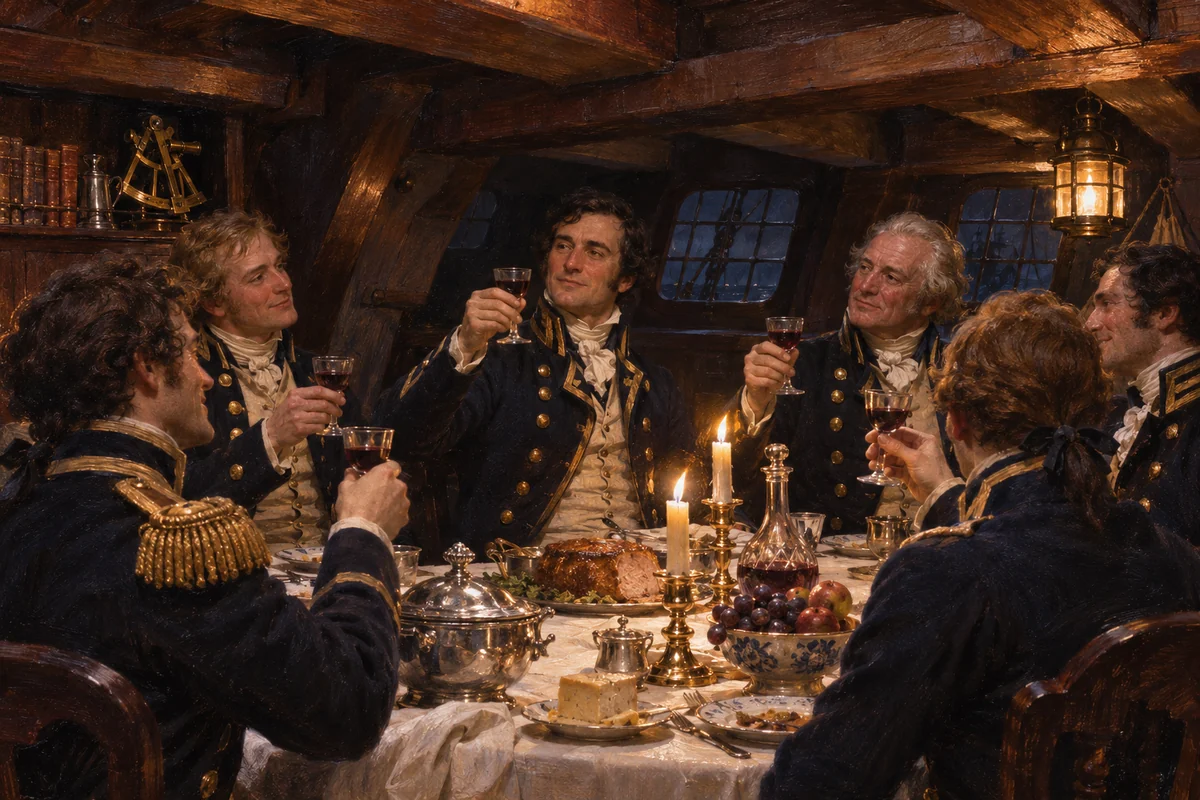
At a formal Royal Navy dinner, the company raises its glasses to the sovereign and usually stays seated. The custom applies even in an officers’ mess ashore, where a low deck beam is unlikely to threaten anyone’s head. That detail makes the most familiar explanation worth a closer look.
The short answer
The Loyal Toast honours the reigning monarch. Royal Navy regulations prescribe a seated toast at formal dinners in naval officers’ messes, both at sea and on land, with specific exceptions. Low overhead beams make a plausible explanation for how the custom began aboard wooden ships. Stories about a particular king bumping his head or granting the privilege are harder to substantiate. Another angle on britain’s maritime working traditions comes from the Royal Navy’s dog watches.
What happens at a naval dinner?
The wardroom is the officers’ mess, a place to dine and spend time together. At a formal dinner, the Loyal Toast marks the end of the meal, though certain official toasts may immediately follow it. The King’s Regulations say that officers in Royal Navy and Royal Marines messes should generally remain seated, even if the National Anthem is played. The seated rule also applies to specified senior ranks at formal dinners in their own messes.
There are exceptions. When a member of the Royal Family attends, the company normally stands unless the royal guest asks them to remain seated. When foreign official guests are present and the programme includes toasts to foreign heads of state, the King’s toast is also taken standing. A guest who has heard only that the Navy sits for the Loyal Toast has learnt the custom in shorthand. Compare this with the lemons behind the nickname limeys and the Royal Navy’s farewell to its rum ration.
The king who hit his head
In one telling, Charles II rose to answer a toast aboard the Naseby, struck his head on a low beam and gave naval officers permission to stay seated in future. The ship is a genuine part of his story. Royal Museums Greenwich records that he boarded the Naseby in the Netherlands in 1660, renamed her Royal Charles and sailed back to England at the Restoration. The record confirms the voyage. The bump belongs to the later story about the toast.
Another version credits William IV, who went to sea as a midshipman at thirteen and became known as the Sailor King. A third gives the honour to George IV, who is said to have told officers to keep their seats because their loyalty was already beyond question. The stories use different kings to explain the same courtesy.
What the evidence actually says
A timber warship gives the low-beam explanation some practical force. A crowded dining space below deck was a poor place for a whole table of people to get up at once. The custom makes sense in that setting, but a sensible explanation for a practice tells us little about when it began or who first authorised it.
The documentary trail is firmer once we turn to the rule itself. The Navy’s published regulations make clear who generally stays seated and when the company stands. A U.S. Navy ensign’s account of dining at the British naval base at Sembawang adds a view from the table. He began to rise for the toast to Queen Elizabeth II and a neighbour stopped him. For the toast to the American president, the company stood. The difference was visible enough to catch a visitor by surprise.
Why it stuck
At sea, staying seated may once have been the convenient thing to do. Ashore it became a recognisable part of how the Navy conducted a formal dinner. A room with a high ceiling is as good a place to see the custom as the cramped cabin in the story. The table still raises its glasses together, and that is where the ceremony lies.
Related curiosities
Why Did Royal Navy Sailors Hold a Funeral for Their Daily Rum?
Why Did Sailors Hold Mock Trials When Crossing the Equator?
Why Did Eight Bells Mark the End of a Sailor’s Watch?
Sources & further reading
- Royal Navy — The King’s Regulations for the Royal Navy, BRd 2, chapter 93, paragraph 9317
- U.S. Naval Institute, Naval History — A Royal Navy Mess Night
- Royal Museums Greenwich — The Departure of Charles II from Scheveningen, 23 May 1660
- Historic Royal Palaces — William IV: The Unexpected King
- UK Ministry of Defence — Defence Catering Manual, Food Service Management and mess customs
Last checked: 25 November 2026.