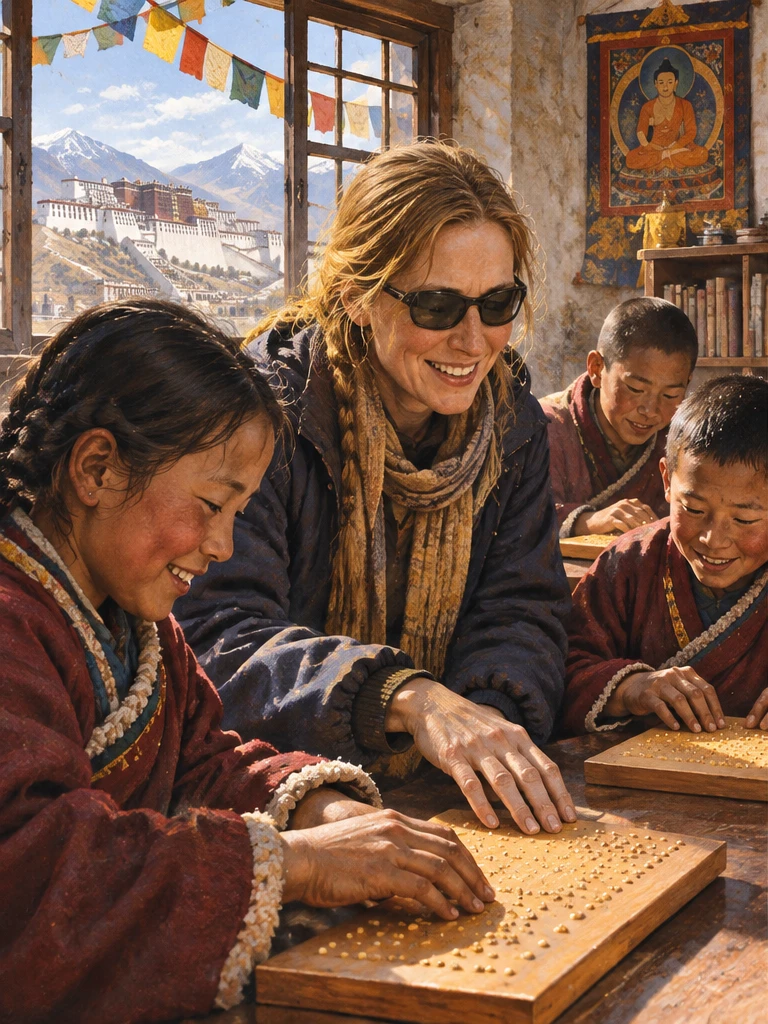
When Sabriye Tenberken travelled to Tibet, blind children had few opportunities for formal education. She had already developed a way to write Tibetan in Braille. What she helped build next was far more than a school: it was a place where children could imagine independent futures.
A journey everyone thought was too difficult
In 1997, a young German woman travelled through Tibet with an unusual ambition. She wanted to find children who were blind, learn how they lived and discover whether they could be offered an education that had largely been denied to them. Other stories about communities built through education and care include Alice Ball’s leprosy treatment and Jeanne Baret’s voyage around the world.
Her name was Sabriye Tenberken. She was blind herself.
To outsiders, the plan sounded impractical. Travel was difficult. The distances were immense. Language, geography and unfamiliar institutions created obstacles even for experienced visitors. Yet Tenberken had something that most of the people advising her did not: an intimate understanding of what blindness did and did not prevent a person from doing.
She had already devised a Braille system for Tibetan. Now she wanted to find out whether that invention could make a difference in real lives.
The result would be a school, a new educational approach and a remarkable partnership that challenged assumptions about disability.
Losing sight without losing curiosity
Sabriye Tenberken was born in Germany in 1970. A retinal condition progressively affected her vision during childhood. By her early teens she was blind.
Her family encouraged her to explore rather than withdraw. She learned to navigate the world using touch, sound, memory and language. Blindness changed the ways she encountered places, but it did not extinguish her appetite for them.
She developed a particular fascination with Tibet. Its language and culture drew her towards university study in Bonn, where she pursued Tibetology and Central Asian subjects.
That decision presented a practical problem. Tibetan did not have an established Braille writing system available to her for academic study. Reading printed texts depended on help from others. If she wanted to work independently, she needed a different method.
So she set about creating one.
Inventing a way to read Tibetan by touch
Braille was already a well-established tactile writing system, developed in nineteenth-century France. Tenberken did not invent Braille itself. Her achievement was adapting its principles to Tibetan, a language with a very different writing structure from German or English.
In 1992, while studying at the University of Bonn, she developed a Tibetan Braille system. It was initially a practical tool for her own learning. Its symbols represented Tibetan sounds and linguistic features through arrangements of raised dots.
The script was examined by a Tibetan scholar, who recognised its potential usefulness to blind Tibetan readers. It was later officially recognised.
This was more than a clever academic solution. It meant that a child who could not see printed Tibetan might nevertheless learn to read and write in their own language.
Literacy could become possible without relying entirely on a sighted person to interpret every page.
But a writing system cannot change lives if children never have the opportunity to learn it.
Finding children nobody expected to educate
In 1997, Tenberken travelled through the Tibet Autonomous Region to investigate conditions for blind and visually impaired people. Accounts of her journey describe travel between towns and remote communities, sometimes on horseback and with local assistance.
She encountered families facing poverty and limited access to specialised education. Some children had been isolated at home. Others had been made to feel that blindness was a source of shame.
Social attitudes were not uniform across Tibet, and no single story can represent every family. But Tenberken found enough exclusion to understand that introducing a Braille alphabet alone would not be sufficient.
Children needed teachers. They needed a safe place to learn. They needed practical skills and a chance to meet others with similar experiences.
They also needed adults who expected them to succeed.
Tenberken began imagining a training centre that would combine literacy with confidence and independence.
The chance meeting that became a partnership
During her travels, Tenberken met Paul Kronenberg, a Dutch engineer. They discovered a shared interest in doing work that mattered and discussed her idea for a school.
Later, Tenberken contacted him again. Kronenberg left his job and joined the project. Together they returned to Tibet in 1998 to establish a training centre for blind children in Lhasa.
The partnership mattered. Tenberken brought language expertise, firsthand experience of blindness and a clear educational vision. Kronenberg contributed practical, organisational and technical skills. Tibetan teachers and local colleagues were essential to making the school work.
This was never simply a tale of one European visitor arriving with all the answers. The project depended on collaboration with the children, families and local community.
Six children and a new beginning
The first school began with six children drawn from different parts of the region.
They arrived with different experiences, dialects and levels of confidence. Some had little formal education. Teachers themselves had to learn the newly developed Tibetan Braille system.
Early lessons used tactile teaching aids, including wooden boards with raised markers. The children learned letters and words through their fingertips.
But the school was not only about reading.
Pupils studied languages and everyday skills. Later training included practical activities intended to help young people work, travel and take part in their communities.
The philosophy was straightforward: education should not merely keep blind children safe. It should help them make decisions for themselves.
A child once regarded as incapable could become a student, a reader and eventually a person able to teach others.
Why confidence mattered as much as Braille
Blindness does not automatically prevent someone from learning. The barriers are often the absence of accessible materials, inadequate teaching and low expectations.
Tenberken understood that children who had been told they could do very little might initially believe it themselves.
Learning to read was therefore only one part of the transformation. The children also needed chances to move independently, ask questions, make mistakes and discover their abilities.
Accounts of the school describe pupils developing strong language skills and learning vocational subjects. Some graduates went on to work or contribute to educational and community projects.
It is tempting to tell the story as though every child instantly escaped hardship. That would be misleading. Disability discrimination, poverty and limited opportunities do not disappear when a school opens.
But the centre offered something profoundly important: an alternative to the assumption that blindness meant dependence.
Braille Without Borders
The school became associated with Braille Without Borders, an organisation co-founded by Tenberken and Kronenberg.
Its name captured the ambition behind the work. Literacy and opportunity should not stop at a national border or at the edge of what society expects a disabled person to achieve.
The founders later helped establish an international institute for social entrepreneurship in India, known as kanthari, which supports people developing projects in their own communities.
That expansion reflected a wider principle. People who have experienced exclusion are not merely recipients of charity. They can be innovators, leaders and problem-solvers.
The most effective support may be the support that allows someone to act on their own ideas.
The danger of turning her into a miracle story
Sabriye Tenberken's achievements are genuinely extraordinary. They do not need exaggeration.
Some inspirational retellings describe her as a lone woman who single-handedly rescued Tibet's blind children. That framing overlooks Paul Kronenberg, Tibetan teachers, local collaborators, the students and their families. Related examples can be found in Irena Sendler’s effort to preserve children’s names.
Others suggest she invented Braille itself. She did not. She developed a Tibetan-language adaptation of the system.
And while interviews document serious stigma towards blindness in some communities, it would be inaccurate to claim that every Tibetan family held the same beliefs or treated blind children identically.
The documented story is strong enough: a blind student recognised an accessibility gap, created a tool, travelled to understand the people who might use it and helped build an institution around their needs.
The lesson the children taught the world
The most compelling part of Tenberken's story is the reversal of expectations.
People questioned whether a blind woman could travel through Tibet and establish a school. She went anyway.
Children who had been told that they could not learn were given tools and teachers. They began to read, write and develop practical skills.
The project challenged two assumptions at once: that disability necessarily prevents independence, and that meaningful change must begin with powerful institutions rather than determined individuals working with a community.
Tenberken did not restore anyone's eyesight. That was never the point.
She helped create opportunities for children to use the abilities they already had.
Her most inspiring achievement was not teaching blind children to live as though they could see. It was helping them discover how much they could do without needing to.
What the evidence tells us
WELL SUPPORTED: Tenberken developed a Tibetan Braille script while studying in Bonn in 1992; it was later officially recognised.
WELL SUPPORTED: She travelled through Tibet in 1997 and co-founded a training centre for blind children with Paul Kronenberg in 1998.
WELL SUPPORTED: The project began with six pupils and expanded into broader educational and vocational work.
IMPORTANT CONTEXT: Local teachers, families, students and other colleagues were central to the school's development.
REQUIRES QUALIFICATION: Accounts of discrimination and exclusion are grounded in interviews and personal experience, not a comprehensive survey of all Tibetan communities.
COMMON MISCONCEPTION: Tenberken invented Braille. She developed a Tibetan adaptation of the existing tactile writing system.
Historical sources and further reading
1. Braille Without Borders — History and Tibetan Braille
2. National Geographic — Sabriye Tenberken: Using Adversity to Unleash Innovation
3. Knowledge at Wharton — A School, and a Future, for Blind Children
4. IMD — Braille Without Borders case study (2012)
Last checked: 25 November 2026.