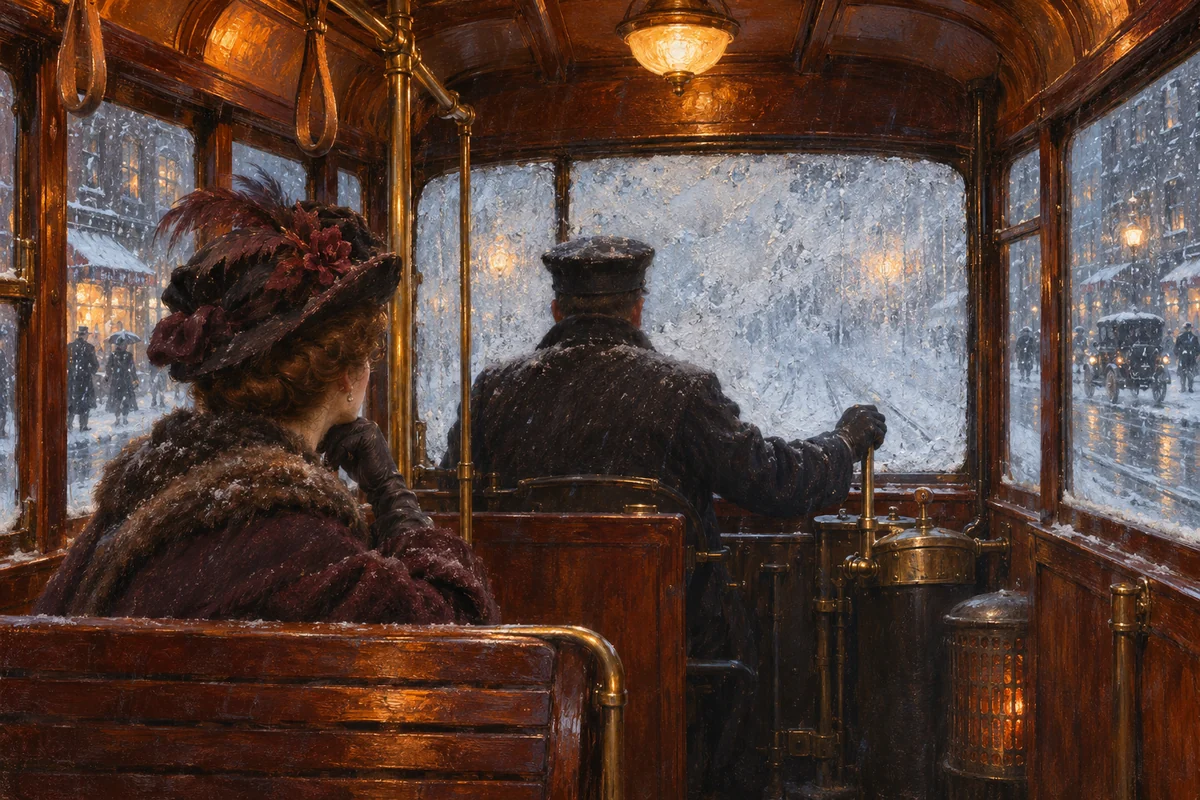
Mary Anderson is said to have watched a New York tram driver struggle to see through falling snow. She went on to patent a device that let a driver clear the glass from inside. Its most familiar feature is still there every time you switch on your wipers.
The short answer
In 1903, Mary Anderson patented a window cleaner that a driver could operate by hand from inside a vehicle. A handle moved an arm across the outside of the glass, sweeping away snow or sleet. The familiar story places the inspiration on a snowy New York tram ride. The patent gives us something more precise than the anecdote. It shows what Anderson actually designed. Related examples can be found in Mary Ann Shadd’s newspaper and its named editors.
The problem on the other side of the glass
In the story told by the National Inventors Hall of Fame, Anderson was riding a New York tram in wintry weather when she noticed how awkward it was for the driver to keep the front window clear. The driver could open the window for a view of the street or stop to clear the glass from outside. Either way, a problem that started with the weather became a problem of how to drive.
Anderson lived in Birmingham, Alabama, and had experience as an entrepreneur and property manager. She turned her attention to a practical question. How could a driver reach the outside of a window without leaving the controls?
Accounts differ on the year of the ride, so the safest date to put on the story is the one the patent gives us. Anderson filed in June 1903, and the United States granted patent No. 743,801 on 10 November that year.
What the patent actually shows
The device worked through a spindle in the window frame. The driver moved a handle on the inside, and an arm moved across the glass on the outside. Anderson described cleaning strips fitted with rubber and a way to balance the arm. The drawings show an arrangement with two cleaning elements, a reminder that her device looked different from the single sweep we might picture today.
Her specification was aimed at electric cars, the term here referring to electric streetcars, and other vehicles. The driver supplied the effort by moving the handle. The important idea was to put control of the cleaner on the sheltered side of the glass and the working part where the weather was.
A patent without a buyer
Anderson tried to sell the rights. In a 1906 letter later discussed by her family on NPR, the Montreal patent agents Dinning and Eckenstein declined to undertake the sale because they saw too little commercial value in it. She is generally reported to have made no money from the patent. Other stories about science and how discoveries get credited include the patent dispute over Margaret Knight’s invention and Josephine Cochrane’s dishwasher patent.
That rejection is tempting to read as a prediction about the future of motoring. The letter tells us something narrower. One company saw little prospect in the device it was being offered. The reasons other firms took up different designs belong to the longer history of the wiper.
From hand lever to everyday fitting
Other inventors explored ways to move the cleaner automatically. Charlotte A. Bridgwood filed for a windscreen cleaner in 1917 and received her US patent in 1918. The National Inventors Hall of Fame records that Cadillac was fitting wipers as standard equipment in 1922. Those milestones show how the problem outlasted any one solution.
The patent securely establishes Anderson’s contribution. The tram story offers a plausible moment of inspiration, but the records do not trace a direct manufacturing line from her drawings to every later wiper. What survived was the practical insight that the driver ought to be able to clear the glass without stepping out into the weather.
Related curiosities
The Woman Who Invented a Dishwasher Because Her Servants Kept Breaking the China
The Woman Whose Invention Was Stolen Because Nobody Believed a Woman Could Invent It
Who Was the Inventor Who Entered a Poisonous Tunnel to Save Strangers?
Sources & further reading
- Mary Anderson — Window-cleaning device, US patent 743,801 (1903)
- National Inventors Hall of Fame — Mary Anderson
- MIT Lemelson — Mary Anderson
- NPR via North Country Public Radio — Alabama Woman Stuck in NYC Traffic in 1902 Invented the Windshield Wiper
- Road Transport History Association Journal, No. 90 — Mary Anderson and the 1906 letter
- Charlotte A. Bridgwood — Wind-shield cleaner, US patent 1,253,929 (1918)
Last checked: 25 November 2026.