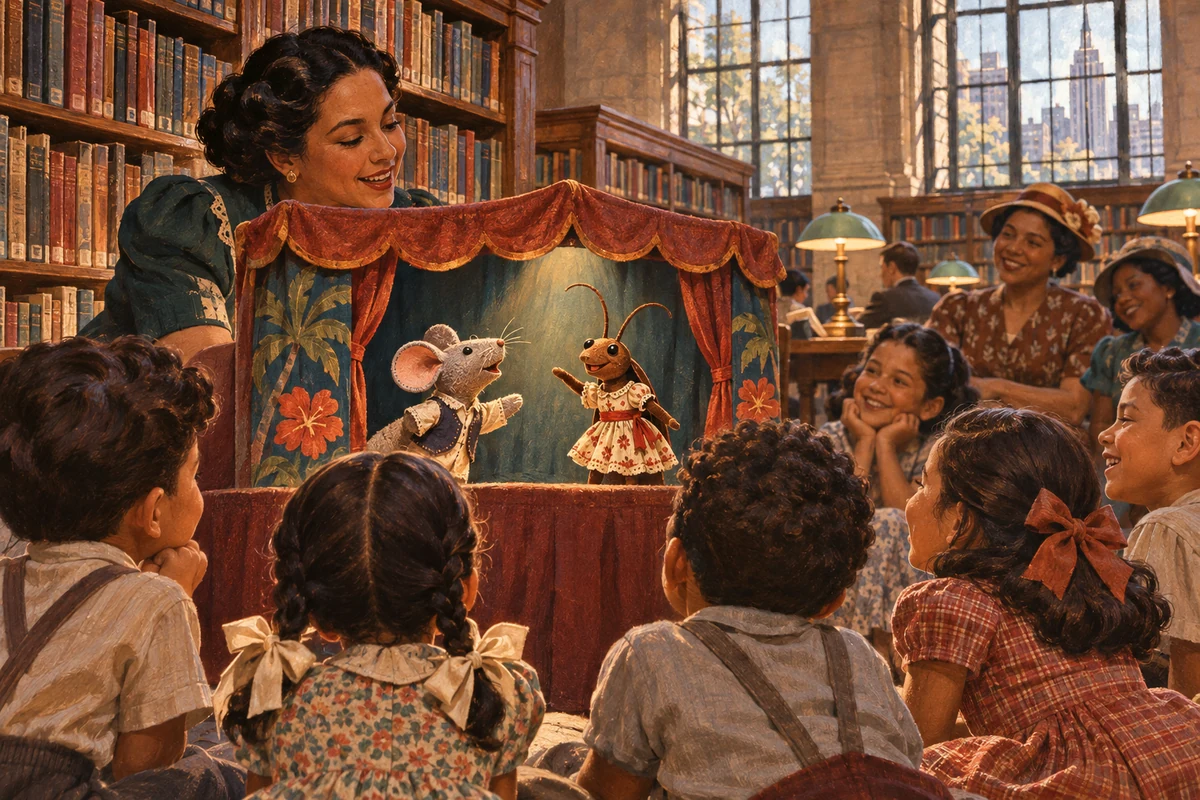
Martina was a cockroach with a balcony and a succession of hopeful suitors. The librarian who brought her to New York children had first heard the story from her grandmother in Puerto Rico.
The short answer
Pura Belpré used puppets to tell Puerto Rican folktales to children at the New York Public Library. Martina, the heroine of her first book, gave her a way to bring a story from her own childhood into the library. Belpré told stories in English and Spanish, and published Perez and Martina in 1932. The children who knew these stories from home could hear them in a public library and, eventually, find them on its shelves. Related examples can be found in the teacher who brought Braille education to Tibet and the children’s author who operated a radio in occupied Paris.
A story the shelves couldn’t supply
Belpré moved from Puerto Rico to New York in 1921 and joined the New York Public Library at its 135th Street branch in Harlem. She was the library system’s first Puerto Rican librarian. The branch’s head librarian, Ernestine Rose, was broadening staffing and services to reflect the neighbourhood, and Belpré worked in the children’s section as the city’s Puerto Rican community grew.
Belpré had stories she knew by heart that the library’s collection couldn’t supply. In a library-school storytelling course in 1925, she wrote down a version in English of the tale her grandmother had told her. Its heroine finds a coin, buys herself some face powder and waits on her balcony as the suitors arrive. She chooses Pérez. Then he takes an ill-advised interest in what’s cooking.
The story travelled in several forms. In Belpré’s book Pérez is a mouse and Martina is a cockroach. The Smithsonian’s catalogue describes other versions with a rat for Pérez, and notes that one stage adaptation made Martina a cricket. The changes are part of the story’s history. A tale passed from one teller to the next can travel quite far before any publisher fixes a version on the page.
Getting a folktale into print
According to New York City Public Schools’ account, the Harlem branch traditionally used stories that had already appeared in print for its story hours. A story could have generations of listeners behind it and still fall outside that practice. Compare this with Sarah Josepha Hale’s Thanksgiving campaign.
In 1932, Frederick Warne published Perez and Martina: A Portorican Folk Tale, illustrated by Carlos Sánchez. The spelling in the subtitle belongs to the original edition. The book credits Belpré for the version she brought to print, and the original edition’s description traces her telling to her grandmother. The story’s publication helped make room for more Puerto Rican tales in the library’s story hours, including unpublished ones.
What the puppets tell us
The strongest evidence comes in several forms. The 1932 edition documents the story’s arrival in print. A New York Public Library photograph shows Belpré with children at a storytelling session. The Smithsonian holds a 1942 Pérez marionette associated with a stage adaptation of the story. These records show the different ways the tale reached audiences. The surviving marionette documents that later production, and its catalogue doesn’t identify it as a puppet Belpré used in her own library sessions.
Belpré continued to use puppets as part of her storytelling. Decades later, in work with the South Bronx Library Project, a collapsible theatre made it possible to take performances from one branch to another. It gave the library another way to reach families whose own stories had once been hard to find on its shelves.
Why her story matters
The Pura Belpré Award, established in 1996, honours children’s and young adult literature that celebrates the Latino cultural experience. Its name remembers a librarian who gave children the chance to hear in public the kinds of stories they already knew from home. For one of those stories, the way in was a small cockroach with excellent prospects and a suitor who should have stayed away from the soup.
Related curiosities
Why Did Doris Lessing Pretend to Be a First-Time Novelist?
How Did a Children’s Author Become a Secret Radio Operator in Nazi-Occupied Paris?
How Did a Woman Born Without Arms Become a Celebrated Royal Portrait Painter?
Sources & further reading
- New York City Public Schools, Pura Belpré: The Librarian Who Brought Puerto Rican Folktales to Life
- Free Library of Philadelphia, catalogue record for the 1932 edition of Perez and Martina
- New York Public Library Digital Collections, 115th Street storytelling group with Pura Belpré
- Smithsonian Institution, Pérez I marionette object record
- American Library Association, Pura Belpré Award