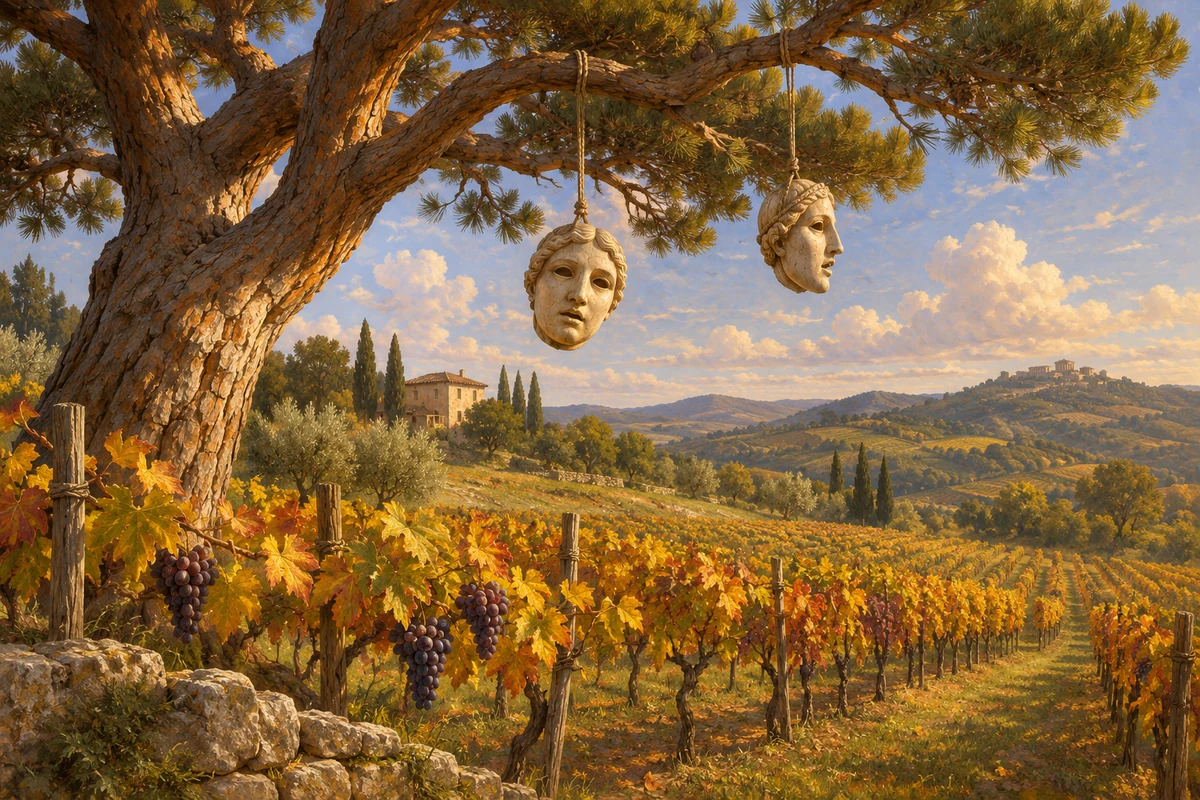
In Virgil’s vineyard, a tall pine holds a curious offering. Something like a little face hangs from its branches. As the god Bacchus turns his gaze, the vines below grow heavy with fruit.
The short answer
In Book 2 of the Georgics, Virgil describes Italian farmers hanging objects called oscilla from a tall pine as part of festivities for Bacchus, the god associated with wine and vines. In the poem, the vines flourish wherever the god turns his head. The passage connects the hanging objects with the hope of a good crop. Later Roman gardens also held suspended sculptures that archaeologists call oscilla. Their surviving hooks tell us how they hung, while their purpose has to be judged from where they were found and what they depict. Other stories about historic spectacles, objects and performers include Charles Byrne’s wish for burial at sea and the theft of Haydn’s head.
A festival among the vines
Much of Book 2 is concerned with the work of growing things. Shortly before the pine appears, Virgil describes the harm animals can do to tender vines. He links a sacrifice of a goat to Bacchus with the damage goats inflict. Then the scene opens out into song, laughter and rural festivities.
Virgil describes farmers wearing frightening masks made from hollowed bark. They sing to Bacchus and hang the oscilla from the pine. The poem gives separate actions for the masks worn by the revellers and the objects suspended from the tree. It is possible to picture the hanging pieces as little faces, as many readers have done, while leaving their exact shape and material open. Related examples can be found in the possible English makers of the Bayeux Tapestry.
The next lines describe vines bearing abundantly. There is fruit in the valleys and wooded places, wherever the god has turned his head. The image suits an object that can turn on its suspension, spreading the god’s attention across a landscape. Virgil gives us that connection through the imagery of the poem.
From the pine to the colonnade
Pompeii and nearby sites preserve evidence of a different setting for hanging sculpture. In the gardens of Roman houses, objects could be suspended between columns along a roofed walkway. Some were shaped like masks. Others were marble discs carved on both faces, so a person could see different scenes from opposite sides.
Two first-century examples in the Miho Museum show what the name can cover. One retains an iron hook and depicts a satyr gesturing towards a theatre mask on one side and the goddess Artemis with her dog on the other. The second shows a follower of Dionysus on one side and Ganymede offering a bowl to Zeus on the reverse. The objects are much more varied than the phrase “little faces” suggests.
Suspension was part of how such pieces were seen. As you walked round a garden, you could come upon the reverse of a scene you thought you already knew. A hanging relief could do something a sculpture fixed flat against a wall could never do.
What the evidence actually says
Virgil’s account is good evidence for a Roman literary description of oscilla offered to Bacchus in a vineyard setting. The garden finds independently establish that Romans suspended carved masks and reliefs as part of their domestic surroundings. Some of the objects carry imagery connected with Bacchus or his followers, giving the two kinds of evidence a point of contact.
The gap between the settings still matters. A carved disc hung between columns may have offered beauty, a mythological reference or several meanings at once. Its similarity to Virgil’s hanging objects gives archaeologists a useful name. It does not tell us that its owner meant to increase the grape harvest.
Why the image stayed with readers
Pruning and tending vines took work that returned with every season. The scene with the pine makes room for what work could never guarantee. Wind could turn a little face and, in the poem, the god might look your way.
Related curiosities
Why Did People Wassail Apple Trees?
Why Does a Spanish Village Throw Turnips at a Masked Monster?
Why Did Scots Tie Red Thread Around Rowan Twigs?
Sources & further reading
- Virgil, Georgics, Book 2, lines 380–396, Latin text in the Perseus Digital Library
- Miho Museum, Two Oscilla with Mythological Figures, first-century marble reliefs
- University of Zaragoza journal Salduie, Un oscillum en Caesaraugusta
- James Yates, Oscillum, in William Smith’s Dictionary of Greek and Roman Antiquities